
There are currently no bills in the legislature relating to a ban on the sale or use of gasoline powered leaf blowers and string trimmers. The most recent bills died in committee this year (2026). Bills have been circulating since at least 2010; long enough for the public, retailers, landscape companies, and government entities (including the health department) to be prepared for (and able to enforce) a complete ban.
The chronic, widespread, and unnecessary use and operation of gas leaf blowers is an affront to human health and welfare; a blight on the environment; and a blaring contradiction to Hawaii’s self-declared climate emergency. The (un) regulated use and operation of gas leaf blowers undermines community well-being and violates the terms of social justice.
The Hawaii constitution provides for a clean and healthful environment. This environmental right, both legal and natural, is afforded to all persons, in particular to future generations. Our government is obligated and has a duty to provide for this right whether a person cares or not about noise, air, and climate pollution from gas powered leaf blowing and string trimming. The harms are not merely subjective annoyances, they are objective, science based fact. A clean and healthful environment is a shared right. This right supersedes the economic position of retailers and trade associations, and holds those who would make laws ensuring this right, responsible for the ongoing harm.
Views expressed disclaimer:
The views, opinions, analyses, refutations, perspectives, objections, characterizations, research, and at times redress, on this website belong solely to the individual author of this website, and pertain to widely published, public records as well as to the tireless research and campaigning of others for quiet, clean communities.
This website is an ongoing project, in its beginning stage, currently aimed at an audience of legislators. Errors and disagreement with the arguments on this website should be brought up immediately via the contact form.
Contents
What did the most recent bills look like, and why did they die in committee? Is this right?
(1) 2023-2024 (Air Pollution)
(2) 2025-2026 (Noise Pollution)
Why ban gas leaf blowers and string trimmers?
Crafting a new ordinance for 2027
(1) Protecting the right to a clean and healthful environment
(2) Protecting environmental quality of life
Protecting the health and welfare of the public:
(3) A new definition of noise
(4) Decibels alone are an inadequate measure
(5) Air pollution is not preempted
(6) Protecting the health and welfare of children and low wage workers
(7) Protecting the health and welfare of the natural environment
(8) Protecting the health and welfare of the climate
(9) Protecting quality of life: unjust time of use
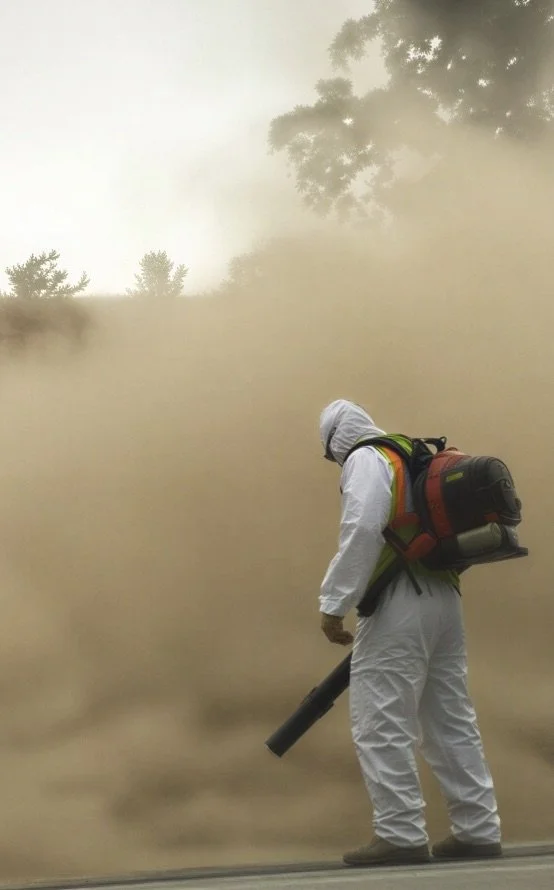
Photo by Henry McGilton courtesy of C.H.A.S.E
Why should we ban gasoline powered leaf blowers and all string trimmers?
Violation of the right to a clean and healthful environment
Toxic battery chronic, widespread exposure to air pollution and fugitive dust; chronic, widespread, and unregulatable noise pollution
Near-term climate pollution in a state that was the first to declare a climate emergency
Unregulated microplastic pollution from string trimmers in an already overburdened state
Environmental and social injustice children and workers are disproportionately harmed
Harm to the land that sustains us
Trespass on our right to quiet enjoyment
Moral injury ‘we cannot prevent acts that violate our core moral values or ethical codes’.
What did the most recent bills look like and why did they die in committee?
(1) 2023-2024 Bills (air pollution)
Senate Bill (SB) 54, and its companion (HB) 575, proposed to ban the sale, offer of sale, and use of gasoline-powered leaf blowers in any urban land use district because the ‘exhaust and sound emissions from gasoline-powered leaf blowers are a great concern for the State's public health and welfare’.
Government entities were not to be exempted.
Why did these bills die?
2023-2024 Testimony: SB 54 and companion bill HB 575
In short:
State Attorney General Lopez advised the committee against an appeal to ‘exhaust emissions’ citing a potential conflict with the federal government, as a ban on sale and operation 'could be deemed an emissions standard, which is preempted by the CAA’ (SB 54). Further, ‘[a] restriction banning all gasoline powered engines in favor of electric may also be deemed an emission standard: ‘“[A] mandate requiring a specified percentage of manufacturers in state sales to be of "zero-emission vehicles" was found to be a preempted "standard" under CAA § 209)”’ (HB 575). The AG recommended ‘creating an objective standard to restrict use of equipment creating noise over a certain decibel level in certain circumstances’ (e.g. ANSI certification and the 65 decibel limit) (bold added).
The AG comments have implied that air pollution (or anything to do with exhaust emissions) could not be used to justify a ban. The bill was rewritten to apply to noise pollution alone, construed only as excessive decibels.
On this the health department cited an inability to properly regulate noise from leaf blowers because they are mobile sources of pollution, as opposed to stationary. Enforcement of any ban would also require funds and staff that the health department did not have.
Direct opposition to the bills came from the Retail Merchants of Hawaii and the Outdoor Power Equipment Institute (OPEI), with both claiming economic harm and the inefficiency of commercial battery or electric leaf blowers.
The Director of Facility Maintenance and the Director of Parks and Rec. jointly opposed HB 575 on the grounds that the use of gas leaf blowers, regardless of pollution, is nonetheless ‘critical for proper maintenance of City-owned properties throughout the island of Oʻahu’, and claimed that ‘[b]attery-powered leaf blower operability usually lasts 20-40 minutes on a full charge, which would drastically hamper our operations, and impede our ability to effectively and efficiently provide services and perform maintenance actions’.
The Superintendent of Education, while recognising the harmful impacts of gas leaf blowers, likewise appealed to the cost and inefficiency of battery operated leaf blowers, especially for the maintenance of schools with large acreage (HB 575).
The Major of District 7 of the Honolulu Police department (HPD) deferred to the Supremacy Clause put forward by the AG, and directly opposed the bill citing issues with forfeiture of equipment on a third violation (enforcement). HPD’s evidence room or other spaces would not be equipped to store gas leaf blowers because their oil and gas mix is hazardous and storage is costly. Another reason is that HPD would be forced to destroy the equipment, since it could not be auctioned in the face of a ban, and ‘disposal of hazardous materials’ is costly.
From the standpoint of enforcement, HPD opposes the bill because time of use restrictions would be ‘far more reasonable’. (HB 575).
Is any of this right?
The long read:
(i) Conflict with federal government regarding emission standards
Attorney General Lopez advised the committee that ‘[r]egarding exhaust emissions from gasoline-powered leaf blowers, Congress has explicitly preempted regulation’:
‘No State or any political subdivision thereof shall adopt or attempt to enforce any standard or other requirement relating to the control of emissions from . . . new nonroad engines . . .’. 42 U.S.C. § 7543(e)(1).
According to the AG (SB 54), the preemption is explicit: ‘Preemption exists when federal law so thoroughly occupies a legislative field "as to make reasonable the inference that Congress left no room for the States to supplement it.”’ (All emphases added).
'"Field preemption" occurs when Congress indicates in some manner an intent to occupy a given field to the exclusion of state law”’. The field being emission standards.
Put simply, as OPEI (cite) likes to argue, ‘the U.S. EPA has sole jurisdiction for small engine emission regulations’.
With regard to HB 575, the AG argues that ‘a mandate requiring a specified percentage of manufacturers in state sales to be of "zero-emission vehicles" was found to be a preempted "standard" under CAA § 209’.
The state is not at liberty to create its own regulations regarding gas leaf blower exhaust emissions, where zero emissions is also considered a ‘standard’. Hawaii is at liberty, however, to regulate ‘noise concerns’ because they are not federally regulated.
⁉️ Is this right?
How does a state’s ban on the sale and use of gas leaf blowers equate to regulation of an EPA emission standard on new nonroad engines?
The EPA’s ‘emission standard’ ‘limits the quantity, rate, or concentration of emissions of air pollutants’ in the manufacture of new engines. For mobile sources of air pollution; standards are set for the ‘specific pollutants being emitted’ (six exhaust and evaporative pollutants).
EPA regulations for non road engines ‘address only the permissible emission rates from new, certified products’. Thus, ‘State and local governments have limited authority to set emission standards for new products’ (Heavily polluted (non attainment) states can adopt California’s emissions standards, but Hawaii’s air pollution is considered to be in attainment). In attainment, Hawaii cannot make its own, stricter emission standard for the manufacture of new equipment by further limiting, or controlling the amount of carbon monoxide emitted for example.
However, states and local governments are permitted to ‘adopt regulations that restrict the use and operation of most products that are no longer new’.
‘Most’ appears to preclude `new locomotives'' and `new engines used in a locomotive’ (section 209 e 1B).
‘New’ means that the equipment has not been sold to an end user and ‘placed into service’. That is, it is still on the shelf, ‘brand new’, at the retail store; it has not been used or operated. Once the equipment is placed into service, and no longer ‘new’, States and local governments are at liberty to regulate such use and operation.
‘A nonroad engine, vehicle, or equipment is placed into service when it is used for its functional purposes’: leaf blowers are used to blow leaves, dust, and debris. To do this the ignition must be turned on and the equipment moved about by an operator, i.e. operated. What can be regulated then is the use and operation of the machine, that is, leaf blowing, in and of itself.
When use and operation is banned, air pollution is necessarily reduced. The EPA cannot mean to say that states must endure unnecessary air pollution, or that gas leaf blowers are required by law.
It seems clear that ‘room’ has been left for states to supplement the emission standard for small non road engines by regulating use and operation of the equipment, that is ‘leaf blowing’ as such.
In the letter of advice, Attorney General Lopez acknowledges that ‘Hawaii is not precluded from regulating the use and operation of leaf blowers, including hours of operation, altogether’. Here, ‘use and operation’ is taken to mean ‘time of use’ (where, when, and for how long the equipment is operated).
On this interpretation, and given the presupposed field preemption, it seems to be inferred that control of gas leaf blower engines with regard to noise pollution e.g. decibel ratings, or time of use (which is not federally preempted), can be grounds for restrictions, but air pollution cannot.
Justifying a ban (in part) intent on reducing the serious and unnecessary health effects caused by the use and operation of leaf blowers is not suppression of criteria pollutants during manufacture. The intention of the ban is to protect the health of Hawaii’s residents and future generations; the health of the environment; and the health of the climate, an exercise of the police powers of the state.
How does a state’s ‘favoring’ of zero emissions (battery/electric leaf blowers) equate to violation of section CAA 209?
In response to HB 575, the AG argues that ‘a mandate requiring a specified percentage of manufacturers in state sales to be of "zero-emission vehicles" was found to be a preempted "standard" under CAA § 209)’ (HB 575).
Note that the mandate relates to ‘vehicles’, i.e. new motor vehicles or new motor vehicle engines. Gas leaf blowers are not vehicles, they are classified as small, non road engines. Further, there is no text in Section 209 relating to sale. CAA Section 177, regards the ‘sale of a new motor vehicle or motor vehicle engine that is certified in California as meeting California standards’.
Presumably, ‘zero’ is a quantifiable amount with regard to exhaust emissions. Obviously, there can be no such thing as a zero emissions gas leaf blower. This is why they are regulated in the first place.
But, could it be the case that a ban on the sale of new gas leaf blowers is an emission standard, given that ‘new’ engines are preempted from regulation by the state, and a new engine is new as long as it has not be put into service?
It doesn’t matter. A complete ban of the use and operation of gas leaf blowers (i.e. gas powered leaf blowing) would automatically pre-empt the sale.
Zero-emissions does not mean zero pollution. Electric/battery equipment nonetheless pollutes the air with particulate matter and noise that harms.
It is not the case that ‘[a]restriction banning all gasoline powered engines in favor of electric may also be deemed an emission standard’; rather, a ban may be deemed a provision of the legal right of all of us to a clean, healthful environment. This is obviously within the state’s police powers. Leaf blowing violates this right. What is regulated with a ban is not the engine’s emissions, but leaf blowing in and of itself, i.e. use and operation.
The 2027 bill would also be regulating/restricting the decibels and time of use of electric/battery leaf blowing.
because this too (obviously to a much lesser degree), causes adverse health effects. Zero-emissions does not mean zero pollution. Electric/battery equipment nonetheless pollutes the air with particulate matter and noise that harms.
The point is, the EPA does not limit control new leaf blower engines as far as decibels and low frequency noise. And because the engine itself does not emit criteria pollutants it surely does not come under the CAA section 9 or any vehicle mandates.
✅ Legal validation for a ban on gas leaf blowers as it relates to exhaust emission standards (including zero-emssions):
In June, 2026 the US district court of New Jersey found that a ban on ‘the use of gas-powered leaf blowers year-round on both private and public property’:
‘does not impose a quantifiable emissions limit, require pollution-limiting equipment or after-treatment specification, or dictate engine-emissions criteria” and therefore does not impose a “standard or other requirement relating to the control of emissions” in violation of the Clean Air Act’.
On appeal, the court found that plaintiffs (residents and landscape companies) failed to show economic harm.
(ii) Retail Merchants of Hawaii: cost, inefficiency, and economic harm
The Retail Merchants of Hawaii opposed SB 54 for the following reasons:
Electric leaf blowers are almost double the cost of gas leaf blowers and thus ‘cost prohibitive for many landscape companies as well as those who take care of their own lawn’.
‘Retailers listen to what their customers want’: ‘There is not a large call for electric leaf blowers’.
‘Technology still needs to be worked on as the equipment has performance issues’.
‘The batteries need constant charging, and some leaf blowers are not as powerful to truly be useful’.
‘[l]ocal businesses would either have to sell these types of gasoline powered blowers at a loss or trash them’.
❗️Is this right?
See response to OPEI testimony immediately below, and response to the Retail Merchants of Hawaii 2024-2025 testimony in the next section.
But consider briefly that ‘burning gas all day long is expensive’.
Research indicates that gas leaf blowers are more expensive in the long run.
(iii) OPEI: no legislation necessary, no authority, economic harm, and ineffiency
⁉️ Is this right?
In defense of pollution as a short term problem
The Outdoor Power Equipment Institute (OPEI), a private, members only trade association, presents itself as the industry ‘Leader in Power Technology and Innovation: In agreement with the Retail merchants of Hawaii, who claim that some electric powered equipment is essentially useless; OPEI argues that gasoline powered equipment has more power and is cheaper for commercial purposes because power, technology, and innovation with regard to batteries is currently lacking.
In a seeming contradiction to the Retail Merchants of Hawaii, who claim that there is no ‘large call for electric blowers’, OPEI argues that zero-emissions equipment (ZEE):
‘is the number one driver of OPE demand and future industry growth’
‘Electric “handheld” leaf blowers and electric hedge trimmers represented approximately 80% of all handheld leaf blower and hedge trimmers shipments in 2022.
The purpose of the inadvertent contradiction is to argue that ‘the majority of “handheld” products shipped are already ZEE’. Gas leaf blowers will die out on their own (eventually), so legislation is unnecessary. Nonethless, it will still be a while because technology needs ‘further advancements’ for commercial landscapers to be able to get as much efficiency (profit) out of them.
OPEI seems to have forgotten that the problem is chronic air and noise pollution, now, that is, the public’s health, and the climate’s health right this moment. Is it feasible to get rid of something that creates widespread health harms unnecessarily? It is not feasible to those who profit from it. Why should people continue to suffer air and noise pollution until technology, that will allow commercial landscapers to make the same amount of profit with electric, evolves?
No one wants to argue that gas leaf blowers are the only culprits, but their unnecessary contribution to poor health outcomes for people, environment , and climate, is nonetheless widely undisputed.
What are the standard arguments from OPEI in opposition to bans around the nation?
OPEI argues that ‘“Facts” comparing outdoor power equipment emissions to automobiles are not rooted in sound data and are false’.
This relates to long-established claims against gasoline powered leaf blowers, used by our own legislators, for example, that ‘use of a commercial gasoline-powered leaf blower for one hour emits as much smog-forming pollution as a 2016 Toyota Camry being driven one thousand one hundred miles, and more than three times as much pollution as a commercial gasoline-powered lawn mower’ (from HB 575).
It is not quite clear why OPEI thinks the claims are false.
Perhaps, the reason is that gas leaf blowers cannot be regulated in the same way as car as trucks because they are not conducive to catalysts or particulate filters. They are not vehicles. But this only confirms that emissions from gas leaf blowers are necessarily worse regardless of comparisons with cars and trucks. They are incapable of meaningful regulation short of a ban.
(1) Regarding what regulation there is, OPEI argues that ‘the EPA is on its third phase of pollutant controls for small engine-powered equipment, resulting in up to 90% reductions in exhaust gas and evaporative emissions from previously unregulated machines’.
While there is no doubt that OPEI has had a significant impact on the reduction of small engine pollution over the past 30 years, and we are appreciative, the third phase alone does not account for the 90%, nor does it specifically apply to gas leaf blowers or string trimmers, it applies to all kinds of small engine equipment, e.g. ‘lawn and garden equipment, utility vehicles, generators, and a variety of other construction, farm, and industrial equipment’.
Further, according to the EPA final rule announcement for the third phase: ‘[w]e are not adopting new exhaust emission standards for handheld emissions’. ‘Handheld’ presumably meaning gas leaf blowers and string trimmers (bold added). No new exhaust standards this equipment have been put in place since 2010-2011.
What was adopted with phase 3 was new evaporative emission standard of 45% reduction concerning specific fuel emissions (for all small non road spark ignition engines). This is good news regarding the gag-inducing stink of toxic gasoline fumes at dinner time, but gas leaf blowers still emit particulates and exhaust, which are difficult to contain given the incomplete combustion of two stroke engines (cite). Thus, they are difficult to regulate, as demonstrated by the lack of a new exhaust standard with phase 3 (circa 2011-212).
OPIE member’s own testing contradicts scientific studies on battery life (cite).
One wonders why battery technology has advanced with residential equipment, but not commercial.
(2) OPEI, on its website, and in testimony around the nation, also appeals to Attorney General Lopez’s comments regarding field exemption and attainment and claims that ‘[t]he U.S. EPA Has Sole Jurisdiction for Small Engine Emission Regulations’. (See response above).
Unburned fuel is inefficient
(iv) Department of Health: leaf blowers are mobile sources of pollution; enforcement is not feasible:
The Department of Health , responsible for ‘public health and welfare’ as it relates to ‘noise control’, deferred to the legality of a ban on sale and use, per the AG. They then argued that ‘[e]nforcement against gasoline-powered leaf blowers would be extremely difficult due to their mobility and duration of use. In addition: '[a]ny new mandate will require additional resources for the amendment of rules and serious enforcement’ which is not in the budget. ‘Proposed requirements will require additional staff time and effort’.
Further, ‘[t]he intent of 342F, Hawaii Revised Statutes (the statute to be revised) was to regulate noise sources that are either fairly constant in nature, stationary, or restricted to a certain location, and can feasibly be enforced’ [italics added].
⁉️ Is this right?
It seems that catching leaf blower operators in the act of polluting and (unintentionally) harming would require constant boots on the ground and money to fund them. Enforcement can’t be everywhere at once (unlike leaf blowers). But anyway, by the very fact of their mobile nature, the landscape crew would be gone before enforcement could arrive. As such, only stationary sources of noise pollution come under the health department jurisdiction with regard to Community Noise Control. This seems to be why it is only time of use that can be regulated at, i.e. where, when and for how long a leaf blower can operate.
With stationary polluters (e.g. a generator), an enforcement officer can literally go to the stationary property (certain location), measure the noise with a decibel meter, verify the duration, and issue a citation to the owner of the stationary property because the property the generator sits on will not be gone by the time they get there, just like the generator itself (as opposed to a mobile property, such as an RV). It is not the generator that gets a citation, it is the property owner.
It seems that gas leaf blowers are for all intents and purposes no better than car stereos in terms of what can be done about mobile noise pollution.
But, non-road gas leaf blower noise is not like the momentary, literally mobile stereo blasting ‘excessive noise’ from a mobile property (car), on the road. Just like the generator on a business property, the property (e.g. school, park, business, home, library etc.) on which a gas leaf blower is used and operated is itself stationary, that is, immobile, fixed in place.
Gas leaf blower operators turn on the noise anywhere from 15-120 minutes plus at certain locations (unlike the car stereo). Moreover, leaf blowing usually occurs during and after string trimming and clearing. The weed whacking and leaf blowing is restricted to the certain stationary house on the corner, for example, or, very often, restricted to all the houses on one certain street on a certain day and certain week. We can be certain that the street won’t move.
Moreover, the day and time of the leaf blower’s operation is generally known, either by a property owner, neighbor, landscape company, government agency, or public entity.
On this, the usual schedule of a landscape or maintenance crew, who indirectly and inadvertently violate the health of children at a school, or the health of people in 90 nearby homes, is ‘fairly constant in nature’ and the use and operation of their gas leaf blowers ‘restricted to certain locations’ for a significant amount of time. Gas leaf blowing is generally constant and predictable. It is not mobile in the sense that a car stereo is.
✅ Funds and feasible enforcement
This means that gas leaf blowers are not mobile, unenforceable sources of pollution. Enforcement is feasible.
Funds collected from a properly supported community reporting system with strictly enforced, and legitimate fines, would provide the ‘additional resources for the amendment of rules and serious enforcement’ currently lacked by the health department.
Gas leaf blower day and times are fairly constant, restricted to a certain location, and the appearance of gas leaf blowers (the equipment) easily identifiable. This suggests that, once a ban is enacted, a community reporting system, perhaps incorporated into the one already in place (i.e. 311), which is effectively and graciously managed, will be the foremost means of enforcement.
Community reporting has been successful in enforcing bans around the nation (cite). These are the boots on the ground. People, who have not become complacent, want quiet, clean communities; we can collectively care for each other, with the right, working tools in place, in spirit of reciprocal duty. This would be in tandem with a public awareness campaign, another invaluable aid to self-enforcement; one also grounded in the ‘The Aloha Spirit Law’.
(v) Directors of Facility Maintenance and the Director of Parks and Rec.: inefficiency
The Directors claimed that battery operated equipment would ‘drastically hamper our operations, and impede our ability to effectively and efficiently provide services and perform maintenance actions’. They would not be able to do their job (HB 575).
⁉️ Is this right?
How did Hawaii’s ancestors manage the land?
What seems to be the case here is that gas leaf blowers and string trimmers are way cheaper and faster than additional employees with rakes, metal trimmers, or mulchers.
Is the use of this high-powered, high decibel, high-vibration, toxic fume exposing, gasoline equipment not hazardous to maintenance and parks and rec workers? Are they compensated for this direct and prolonged exposure day in and day out? It doesn’t seem that ear muffs and goggles are quite enough (cite the undervaluing of harm by OSHA). Do they receive hazard pay? Instead of compensating workers for this social injustice, why not take the extra money and hire additional workers who will instead ‘steward the land’ instead of skewering it?
The normalisation, over-importance, and chronic over-use of gas leaf blowing, resulting from its cheap, powerful ability to save time and money, has created a blandscape across the state. How much of this land denuding, in a state where lush greenery is critical to its land management, is actually necessary? (cite the greenery).
Why not lead by example?
In a state that has declared a 50% reduced emissions goal for 2030, why are our government entities not already leading by example? (Noticing that the Aloha+ Challenge could be deemed an emission standard). They could commit to not buying anymore gas-powered equipment instead of praising its misconceived virtues.
Instead of electrifying our government fleets at some point in the future; it is only logical that we would first electrify the toxic gasoline powered equipment that these (significantly less polluting) vehicles carry to roads and parks around the state.
Working with the American Green Zone Alliance (AGZA), several municipalities around the nation have fully transitioned their maintenance operations to electric equipment. (see Gov. Programs).
(vi) The Department of Education: cost and inefficiency
According to the Superintendent of Schools (HB 575) the Department of Education ‘recognizes that gasoline-powered leaf blowers have a harmful impact on health and the environment’. One problem is the ‘cost to replace inventory’ (with battery equipment). The other problem is that ‘battery-operated handheld equipment technology does not have the power needed for large areas’, for example: ‘James Campbell HighSchool is 38 acres, and Hilo High School is 24 acres.some of the school grounds are as much as 38 acres’ (sic).
Further, ‘Principals have found that battery-operated equipment operates at homeowner strength and not the commercial strength needed for a larger school campus’.
⁉️ Is this right?
What about the cost to children’s health of this cheap equipment that for no right or good reason harms their health and impacts the environment that they are supposed to be learning in?
Following the Directors, here is another example of the popular notion that cheap, powerful, even more deafening than ‘homeowner strength’ equipment is more efficient because the job is done quicker. Blow all the junk away, and then come back and do it again, after it all blows back. What is this? Job creation?
Lead by example
In support of the probably dead Environmentally Friendly School’s Act, why not have children come out and rake the leaves, learn how to identify plants as they pull weeds, and pick up the plastic for recycle? Why not roll this stewardship learning into a high school graduation requirement of community service, as other states and local districts have done.
Regarding acreage, Smithsonian Gardens manages 180 acres of gardens, landscapes and grounds by making ‘use of electric tools to complete daily grounds maintenance tasks’ (‘including electric blowers, trimmers, mowers, edgers, tillers, and even a chainsaw’). They are not the only major institution leading by example (cite).
ꜜThe Department of Education also opposed a ban in the 2024-2025 testimony, again, completely overlooking the harms to children, which is addressed in the next section.
(vii) Honolulu Police Department (HPD): hazardous waste preempts enforcement
After deferring to the AG’s Supremacy Clause warning, HPD argued that forfeiture of equipment on a third citation would be costly and otherwise problematic due to the hazardous nature of the equipment. The Department also opposed the bill on the grounds that time of use restrictions (where, when, and for how long) would be ‘far more reasonable’ (HB 575).
⁉️ Is this right?
This opposition from HPD truly highlights the inadequacy of current and proposed fines and the subsequent impotence of enforcement. It also underscores the absurdity and injustice of current time of use restrictions.
If the fines are so weak that a violator has reached the forfeiture stage of enforcement, the violator should be required to drain any gasoline on the spot before surrender. The evidence is the machine, not the fuel. The leaf blower can then be taken to recycling by the violator (within 24 hours), instead of it being put in HPD storage or taken to an auction house. At which point the violator would be required to upload a receipt (within 48 hours) from the recycling center to a reporting system. Failing this, the violator would lose their business licence.
Non compliance is an act of polluting; an environmental crime.
A simpler way to address this is to impose serious fines beginning with the first violation, along with (not instead of) mandatory (environmentally conscious) community service. Community service might include giving a presentation to schoolchildren on stewardship of the land (see the probably dead Environmentally Friendly School’s Act). This would be followed by the uploading of a receipt showing that the community service was honored and the equipment recycled, or face loss of business licence as well as a $10,000 fine (the amount applied to environmental polluters by the Department of Health’s Clean Air Branch). The money would then be used to fund an ongoing public awareness campaign as well an effective, supportive reporting system, and rebates etc. to offset the cost of transition.
!!!given the deleterious effects on the public’s health and welfare, injunctive relief should be allowed in the case of persistent abusers.
Unjust fines
Nominal fines provide no incentive for businesses to comply. These are simply figured into overhead, i.e. the cost of doing business (the business of polluting). If we are to be serious about protecting the health and well-being of Hawaii, we have to be serious about fines and use them to support the overall intention of a clean, healthful environment, not to inadvertently make a mockery of it. Instead of laughable fines that do not even slap a wrist and then make a leap to forfeiture; the fines must be severe, and continued non compliance must result in suspension or loss of business licence. Mandator community service must accompany the fines.
Unjust time of use
How long does it take for daily exposure to exhaust and evaporative gases, dangerous decibels, widespread low frequency noise, acute stress response, inability to function productively, powerlessness to peacefully enjoy one’s property etc.; to cause irreparable harm?
Current time of use restrictions allow for all day leaf blowing, non-stop, 7 days a week, multiple times a day, including Sundays and holidays.
Simply amending the time of use of gasoline powered equipment would be a further nod to state sanctioned pollution, it would be to continue allowing acknowledged and unnecessary harms to the people, children, and low wage workers of Hawaii. The harms will still harm. Harmful impacts occur on a continuum of dosage. No amount of harm is justified.
What did the most recent bills look like and why did they die in committee?
(2) 2024-2025 Bills (noise pollution)
House bill (HB) 30 proposed to ban the use of gasoline leaf blowers by any person at any time in urban districts and apply the existing restrictions (time-of-use) to non-gasoline leaf blowers, while increasing fines (presumably for both). Government entities and their agents were not to be exempted.
The bill argued that gasoline powered leaf blowers create noise pollution (excessive decibels), which causes hearing loss and impairs quality of life, thus harming public health and environment. Given that there are ‘quieter alternatives’ to gasoline powered leaf blowers [e.g. battery operated, mulching, rake, grass-cycling], a ban is justified.
‘Gasoline powered leaf blower’ only extended to two stroke engines.
The act was to take effect on approval.
House Bill (HB) 470 HD2 proposed to prohibit the sale of any leaf blower (gasoline or battery powered) that does not meet the ANSI B-175.2 class 1 rating beginning July 1, 2028. Government entities are not to be immediately exempted. Fines for violation were to be increased.
The bill argued that leaf blowers (both electric and gasoline powered) create noise pollution (excessive decibels), which causes hearing loss and impairs the quality of life for both the residents and landscape workers of the state.
Given that there are ‘quieter alternatives to loud leaf blowers', prohibition of sale is justified.
The act was not take effect till July 1, 3000, presumably allowing several years for transition.
Senate bill (SB) 365 proposed to prohibit the sale of gasoline powered leaf blowers beginning January 1, 2027. Government entities were not to be exempted.
The bill argues that gasoline powered leaf blowers produce extreme noise (conceived as decibels), pollute the air, and exacerbate climate change.
Given that electric leaf leaf blowers are quieter, cleaner, more efficient, powerful, and affordable than gasoline powered leaf blowers; prohibition is justified.
All three bills appeal to ‘quieter (and cleaner) alternatives’, namely, electric/battery operated machinery.
This is the wrong approach. What matters is safer alternatives.
Why did these bills die in committee?
2024-2025 Testimony
Testimony was only given for HB 470 (HD1 and HD2), which largely concerned a ban on sale of leaf blowers that do not meet the ANSI B-175.2 class 1 rating (maximum noise level of 65 decibels (dBA) or lower when measured from a distance of 50 feet).
In short:
The stumbling block seems to come from the Department of Health (noise control). First supporting the use of ANSI B-175.2 class 1 rating as it used by municipalities around the nation to ‘regulate noise emissions from hand-held and backpack gasoline engine powered leaf blowers’ (≤65 dbA), but then finding that ‘inspection’ of equipment for compliance would be too costly for the department in terms of ‘personnel and equipment’. The Department then finds that ANSI B-175.2 class 1 rating, cited in the bill, is outdated, and only applies to gas powered equipment, not string trimmers, and not electric equipment , which are also intended to be regulated under the rating (HB 470 HD2).
The Department also finds it ‘inappropriate’ that all powered equipment come under the rating because it will harm local businesses. People will just go online or elsewhere to purchase high decibel equipment (conceived to be more efficient) since the ban only extends to sale not use and operation.
Further, equipment does not standardly come with decibel level labels, which makes ‘regulating these products simply through noise ratings impractical and presents a regulatory problem’.
The overall stance of the Department is summed up by arguing that hardly anyone complains about leaf blower noise, and that complaints primarily come from urban areas. Noise from gas leaf blowers is not a statewide problem.
The Retail Merchants of Hawaii again imply that they will be economically harmed by a ban on sale of gasoline powered equipment. They again appeal to the inefficiency of electric/battery operated leaf blowers, and further appeal to the potential environmental damage caused by lithium batteries.
Soberingly, the Superintendent of Schools, while agreeing that gas leaf blowers are harmful (to children), again appeals to cost and efficiency.
Is any of this right?
A long read:
(i) Department of Health (DOH): decibels are unregulatable; not a statewide problem
The Department of Health, presumably ‘Noise Control’, finds that regulating decibels is, for all intents and purposes, impossible, because equipment does not standardly come with decibel labels. Further, the ANSI rating only applies to gas leaf blowers, not the string trimmers or electric equipment also to be regulated with a ban. Moreover it seems that hardly anyone complains. Those who do are from urban areas. Noise pollution from leaf blowers is not a statewide problem. As such, the department recommends nominally increasing fines (no forfeiture) instead of banning the sale of gasoline powered leaf blowers.
⁉️ Is this right?
This probably seems right on its face. Regulating decibels looks nigh on impossible and compounding this: noise, while recognised as harmful pollution, is nonetheless regulated as a temporary nuisance (a personal problem to be worked out with your neighbor), with regard to enforcement.
The ANSI problem
Contra DOH testimony, the ANSI rating does not, when looked at more closely, only apply to gas leaf blowers.
The purpose of ANSI/OPEI B175.2-2012 (R2019) is (1) ‘to establish manufacturer requirements to reduce the risk of injury associated with the use of gas leaf blowers (internal combustion). However, (2) ’This standard may also be used to measure bystander sound pressure levels at 15 meters (50 feet)’ (bold added, cite).
So while it’s true that the current edition of ANSI/OPEI B175.2-2012 (R2019) concerns gasoline powered leaf blowers only as it pertains to the safety of the operator; it is also widely used as a standard methodology by leaf blower manufacturers for measuring the bystander sound pressure levels in dbA of electric/battery operated leaf blowers at 50 ft. And continues to be widely used by ordinances, that have instituted bans on gas leaf blowers, to regulate electric/battery operated ones. Presumably, decibels are decibels at the bystander level, regardless of the engine type they emit from.
The ANSI standard, while objective, is still problematic, as DOH points out. Nevertheless, electric leaf blowers, while not emitting harmful low frequency noise, like gasoline powered ones, can nonetheless emit harmful decibels.
✅ Enforcement is not as difficult as it is made out. Requiring registration of all electric/battery equipment, would remove the need for DOH field inspectors altogether. There would already be a reporting system in place for gas leaf blower violations. Equipment owners would upload a receipt with model number and proof of ANSI Class 1 ≤65 dbA, or other proof of ≤65 dbA. This prevents the need to ban the sale of equipment over 65 dbA. If the equipment cannot be used and ≤65 dbA is vigorously regulated and enforced with a registration system, purchasing higher decibel equipment from anywhere is pointless. The registration requirement would benefit local retailers trying to electrify their inventory. Residents, landscape companies, and government entities who already own high decibel electric/battery equipment can apply for a trade-in rebate, or other incentive and perhaps with a short transition period of 3 months. Remembering that leaf blowers are not necessary anyway, particularly in residential areas.
Ideally, residents would make a report to a 311 or other already in-place reporting system by uploading photos and videos (no faces). With this in mind, signage should be required for all maintenance/landscape crews, regardless of business size or operations. The report could be anonymous, or in the form of an affaditvit, thus legally binding (example). The method for enforcing a ban on gasoline would be the same reporting method for battery/electric.
HPD officers (not DOH inspectors), responding to a noise pollution call, could also request a copy of the registration receipt matching the equipment.
‘If it sounds too loud, it is too loud’.
✅ Unwanted noise is not merely a subjective experience
Noise is by definition harmful sound. The perspective of the Health Department, with testimony that complaints merely come from urban areas, seems to imply that these are naturally noisy environments regardless of leaf blowers and so we should not single out leaf blowers. Or maybe the sentiment is that because there is already so much noise, people do not take notice. Because there is a wider problem regarding noise and its control, we shouldn’t really be concerned with leaf blower noise.
The noise produced by gas leaf blowing is not a personal opinion to be challenged by the personal opinions of the health department, your neighbor, or HPD officers. This clearly undermines enforcement, and community harmony. The appeal to subjectivity is dismissive and belittling. Health is a universal right. Leaf blowing is not. The State has the duty to provide for the health and welfare of the residents regardless of whether a person likes gas leaf blowers (or doesn’t). An ordinance banning the use and operation of gas leaf blowers is not about personal choice, it is about legislating for the greater good.
Why does hardly anyone complain?
The argument, presumably from Noise Control, is that ‘the Department has only received 52 total documented complaints regarding noise pollution from leaf blowers over the past four years (2020-2024)’. Further, ‘[b]ased on an analysis of the complaints received, the issue of noise from the referenced sources is not a statewide problem but one primarily impacting urban areas’. This analysis reflects the principle, published in the Oahu Noise Reference Manual, that ‘complaints are generally used as an indication that a noise problem exists’. Thus, if no one complains there is no problem. If the number of complaints from people is small in contrast to the sheer number of people in the state, then the problem is insignificant.
We see this effect locally when ‘complainers’ are told by the authorities that no one else has complained, therefore their complaint is demonstrably false, and duly rejected.
The manual from Noise Control further states that ‘[t]he number of people who file complaints is only a very small percentage of those who are annoyed’. This seems right. There are underlying reasons (themselves health stressors) why people do not complain. They do not want to create community discord; they do not want to be labelled a ‘complainer’ in their community; they do want to be alienated by their neighbors; they are waiting for someone else to do it; they are afraid, embarrassed, or simply agree with the ‘golden rule’, and blame themselves.
How does this protect (or undermine) the health and welfare of the public?
The operative word is annoyed. The public cannot be collectively annoyed and thus warrant proper action with regard to environmental noise. Annoyance, ‘noise annoyance’ is regulated as a temporary, individual or group mental state, the latter verified by the fact that more than one person in a setting is annoyed; several minds agree, and they agree to complain together, which is an objective indicator that the noise is annoying (not physically harmful).
To be in a mental state of annoyance is itself physically harming (psychologically, physiologically, and biologically) (cite). The reference manual clearly recognises that ‘noise’ has these latter two effects on human functioning, but annoyance is treated merely as a psychological state of mind, a temporary feeling or emotion, and thus dismisses the long-term, harmful, physical responses in the body on all people experiencing the constant noise, whether they care or not . Overlooked is the sheer amount of times in a day or week that leaf blowing is allowed to damage neighborhoods. There is clearly a disconnect here between the physical and the psychological (the stress response is real) that continues to allow the proliferation of environmental noise, and harm to public health and welfare, by placing the burden of proof on the individual, or group of individuals experiencing a single event.
Furthermore, what is the point of complaining if the ongoing harm is perfectly legal? There are no decibel limits on gas leaf blowers (nor can there be according to noise control), and just as absurd: gas leaf blowers can be legally operated all day, non stop, 7 days a week, including holidays. Government entities included.
This abhorrent time-of-use sanctions legal trespassing on our waking and sleeping hours, breakfast, lunch, dinnertime, museums, libraries, shopping, school, study time, work, playtime, bath time, lullabies, reading, holidays, homework, sleep, illnesses, recovery, elder care, our concentration, thoughts, feelings, emotions—on our health and in our homes.
We should not have to wait around every member of public across the state to complain before something is done.
⚠️ Contrary to DOH rules, the harms caused by gas powered leaf blowing and string trimming do not affect some more than others. We all breathe the same polluted air. Constant noise affects all of us whether we care or not. Loss of hearing is not subjective. Stress response is not voluntary. Leaf blowing is a statewide problem regardless of complaints as evidenced by the noise harms documented in the Noise Reference Manual. Leaf blowing is a public, not a private nuisance. On this, if the harms are to be taken seriously, the ban must extend to any property public or private across the state, and should apply to all users and operators, including government entities. Otherwise, only the health of urban area residents is protected, as if the rest of the State’s residents do not matter.
Crucially, the definition of noise must be changed to reflect the objective harms of environmental noise rather than the subjective experience. Till then, we must appeal to the precautionary principle.
(ii) Retail Merchants of Hawaii: economic and environmental harm
Citing the same arguments from 2023-2024 , the Retail Merchants of Hawaii add that:
Because Hawaii is so lush, small locally owned landscaping businesses are necessary for property maintenance.
Batteries make equipment heavier.
Short plug-in electric equipment hinders access, reduces efficiency, and increases time on the job.
‘Hawaii does NOT currently have a recycling program or location for Lithium Batteries’.
Lithium batteries ‘can be prone to overheating and catching fire’ and ‘can lead to safety
hazards, such as fires or explosions’.
‘[W]e do not want to see [lithium batteries] discarded in our landfills as improper disposal of lithium-ion batteries can lead to environmental pollution’.
‘Chemicals within the batteries can leach into the soil and water, causing harm to ecosystems’.
⁉️ Is any of this right
While it’s true that policies should be determined by whether people will be better or worse off, and the claim of the Retail Merchants of Hawaii is that small, locally owned businesses will be economically worse off with a gas leaf blower ban; the health of these business owners, their employees, and the consumers they profit from would nonetheless be better off with a ban, whether they care or not.
Otherwise it seems that profiting from the known harms caused to consumers by the use and operation of gasoline powered leaf blowers would, at the very least, appear to violate the Aloha Spirit Law , which can be conceived as a symbolic code of conduct for businesses.
Another thing to consider is that the business of pollution impacts an already broken healthcare system (cite).
It is hard to believe that in opposition to electric equipment, ‘[r]etailers listen to what their customers ‘want’, when research data shows that 93% of Hawaiian residents are concerned about the climate and believe that ‘past warming has been caused by humans’. It is hard to believe that in a state where a clean, healthful environment is enshrined in the constitution and the words of the ancestors; and in a state that was the first to declare a climate emergency, that anyone would ‘want’ gasoline powered lawn care equipment, given that they are near-term climate polluters.
What is demonstrated with this testimony is that the Retail Merchants of Hawaii listen to what (some) of their businesses want, and this is rightly so, but many businesses want to do the right thing, and the obvious potential for economic growth, as we necessarily move towards zero emissions, is what should now be supported and legislated for by the Retail Merchants of Hawaii. Gasoline powered lawn equipment is a regrettable thing of the past that only seems to have exposed the power of money over health and welfare. The Retail Merchants of Hawaii should really now be legislating, on behalf of their businesses, for grants, rebates, trade-in programs, and loans, in keeping with our highest principle that a clean, healthful environment is an ethical obligation as well as an environmental right. The land that sustains us, also has rights.
Efficiency or modern slavery?
In context, the opportunity for economic growth that comes with electrification should not be underestimated. Prices are down; electric/battery equipment is found to be more economical over the long term; and claims of inefficiency are now considered a dead argument. (cite green lawn care workers )
If we put ‘efficiency’ in its proper context with relation to gas leaf blowers, those who are dispsoroprtionaltely harmed by gas leaf blowing (aside from children) are the economically exploited, wage slave workers who use and operate them. ‘Efficiency’ here equates to cheap labor. Four underpaid, unprotected hazard workers for one small property, wielding cheap gasoline equipment, blowing noise, air pollution, and toxic fumes all over the place at 200mph/ 100 decibels, equates to many more properties serviced within the absurd, unjust, non-stop, 11 hour use and operation window mandated by the public health department.
Efficiency, in this negative sense, contributes to significantly more fugitive dust, harmful noise, and environmental damage at the likely cost of workers’ hearing and other body organs. Is this not an appalling abuse of human rights, especially given that leaf blowing is not even necessary, regardless of the size of the property (why not leave the land alone, cite the rewilding argument from guardian)? Thus, as the Retail Merchants of Hawaii agree, the problem with electric is that battery and corded equipment mean less jobs in a day and thus, less money in the bank.
✅ This need for negative ‘efficiency’ is where the cost is prohibitive, not the cost of the equipment or inability to liquidate, since there are ways to compensate for this perceived loss of performance (money) that can be legislated in tandem with a 2027 bill to ban gas leaf blowing and string trimming; e.g. zero emissions loans, rebates, grants, tax abatement, as well as trade-in and recycling incentives, many of which are already available and, at least on its face, need only be broadened to cover liquidation and disposal of gasoline powered lawn equipment.
16 years in the making
The Retail Merchants of Hawaii inadvertently argue that it’s ok for all of us to be worst off as long as some of their members profit. Bills proposing a ban on the sale and/or use of gas leaf blowers have been making the rounds for at least 16 years! These retailers and landscape companies have had an excessive amount of time to navigate the transition to zero emissions, and so have our committees. On this, a phase out is not acceptable, an immediate ban is.
Two wrongs do not make a right.
The widespread, continuous environmental damage from gas leaf blowing is broadly accepted (cite). But it is also true, as the Retail Merchants of Hawaii claim, that lithium ion batteries, are potentially hazardous under certain conditions (like crossing the busy freeway on foot).
The unwitting argument from the Retail Merchants of Hawaii here seems to be that the environment is worse off with electric/battery leaf blowers. Because a gas leaf blower pollutes the environment (every time it is fired up), but doesn’t cause fires or leach chemicals, and because a lithium battery has the potential to cause a fire and leach chemicals; gasoline powered equipment is actually better for the environment, and by implication the sale of gas leaf blowers should not be banned. This of course does not take into account the actual problem; the disproportionate health effects on workers and children caused by these unnecessary air, noise, and climate polluters, for example. Clearly, the benefits of electric/battery operated leaf blowers outweigh their risks.
♻️ Lithium batteries can be safely recycled in Hawaii, at transfer stations, drop-off points, retailers, and through buyback programs (link).
✅ ♻️ Gas leaf blowers can safely be recycled in Hawaii, too.
https://radiusrecycling.com/locations/21/kapolei-hi
https://radiusrecycling.com/locations/124/puunene-hi
Scrap metal is one of Hawaii’s biggest exports. This does not mean that gas leaf blowers are in some sense good, or that their use and operation is justified by the fact that they can be recycled. And while the amount of scrap might seem negligible, the scrap metal value does provide another incentive for liquidation and should provide strong evidence to our legislators, as well as the Retail Merchants of Hawaii, that a ban on gas leaf blowers is morally and ethically, the right thing to do.
The Retail Merchants of Hawaii fail to convince that they will suffer irreparable economic harm (business killed); loss of profit (liquidation); or loss of customers (not what they ‘want’). These losses are part and parcel of doing business in the first place. It could happen with any product. The loss of profit would be recoverable through loans, tax rebates, and other incentives. Further, a commitment to business stewardship would invite more customers in and strengthen standing in the community, as well as demonstrating Aloha..
(v) Department of Education: cost and inefficiency
Representing the Department of Education, the Superintendent of Schools again recognizes that ‘the sound emissions from leaf blowers, string trimmers, and weed whackers have a harmful impact on public health and welfare’. Nonetheless ‘the Department is concerned about the future cost to replace the inventory of leaf blowers, string trimmers, and weed whackers for schools throughout the state including those in urban land use districts once these restrictions are put in place’.
The department is also ‘concerned about the increase in inefficiency since battery-operated handheld equipment does not operate at the commercial-grade strength necessary to maintain larger school campuses. The batteries also need to be recharged frequently and have shorter life spans’ (bold added).
⁉️ Is this right?
Although the Superintendent of Schools rightly recognises that ‘the sound emissions from leaf blowers, string trimmers, and weed whackers have a harmful impact on public health and welfare’; is the superintendent unaware of the particularly insidious harms of noise pollution from this equipment to the children under their care for the greater part of the day?
Is it morally good and ethically right that the harmful impacts on the health and welfare of children are superseded by the unnecessary need to keep the grounds they learn on free from leaves, dust, and debris, cheaply and efficiently? What about their life spans?
It is true that we cannot blame gas leaf blowers for all pollution, but we can invoke the precautionary principle, given the sheer amount of science behind the harms. Would we allow blaring stereos or smoking on school grounds? It is widely held that gas leaf blowers are the new second hand smoke.
A moral injustice: noise and air pollution disproportionately harm children
📖 Read the evidence
✅ There should be no leaf blowers of any kind on the grounds or in the vicinity [to be defined] of a school, or any facility in which children are trying to learn and teachers and care providers are trying to teach and nurture; nor should leaf blowers be allowed to be used and operated on the grounds or in the vicinity of any facility, home, or public building (including libraries and museums) in which children are receiving day care, nursery care, kindergarten, preschool, private tuition, after school care, and/or discovering, reflecting, or learning generally.
That children and infants are subjected to the constant, chronic air and noise pollution produced, in part, by the unnecessary use and operation of gasoline powered leaf blowers is a moral injustice and directly harms future generations whose rights are supposed to be protected by the constitution.
Crafting a model ordinance for 2027
(1) Protecting the right to a clean and healthful environment : noise is not just a community problem
‘Each person has the right to a clean and healthful environment, as defined by laws relating to environmental quality, including control of pollution and conservation, protection and enhancement of natural resources’ (Hawaii Constitution, Article XI, Section 9).
[§342F-3] Duties, rules, powers, appointment of hearings officers. (a) In addition to any other power or duty prescribed by law and in this chapter, the director shall prevent, control, and abate noise pollution in the State’.
⁉️ Why is nothing done to prevent, control, and abate leaf blowing noise, then? Our right to a clean and healthful environment seems to clearly be violated.
What are the laws or rules relating to noise?
Rather than ‘environmental noise’, noise is classified as ‘community noise’ and presumably stands in opposition to occupational noise.
Where ‘environmental noise’ would be a general catchall for the natural world as well as physical surroundings; ‘community noise’ more specifically reflects neighborhood noise and indoor, residential noise.
This is important because ‘community noise’ does not clearly imply an ‘environmental quality’ in the way we might mean it to, and so even as the state recognizes noise as ‘pollution’, the right to a clean and healthful environment appears unprotected with regard to noise pollution.
Further, ‘noise’, as it is defined by the laws, is itself problematic.
Under ‘Community Noise Control’ the law makes a distinction between ‘noise’ in general, which is subjective and thus cannot be substantiated, and ‘noise pollution’, which is objectively substantiated by a decibel meter.
(i) '"Noise" means any sound that may [or may not] produce adverse physiological or psychological effects or interfere with individual or group activities, including but not limited to communication, work, rest, recreation, or sleep’ (Title 11-46-1) (emphasis added).
(ii) "Noise pollution" means noise emitted from any excessive noise source in excess of the maximum permissible sound levels’(11-46-4).
Noise Section clarifies the distinction as noise that can be regulated and noise that cannot.
‘Noise pollution’ refers to industrial, agricultural, or construction related noise, which is noise that is ‘fairly constant in nature, stationary, or restricted to a certain location, and can feasibly be enforced’. It is noise that is, for all intents and purposes, stationary.
‘Noise’ alone refers to noise from ‘people’ or ‘nuisances’, which is not regulated because this type of noise is, by definition, subjective or of a psychological nature.
Leaf blowing noise is not regulated.
Regulated noise:
Hawai’i Revised Statutes, Chapter 342F defines noise as ‘pollution’.
As it relates to environmental quality, ‘pollution’ is further defined as ‘excessive noise’.
‘Excessive’ is defined as noise “of a volume or in quantities and for durations which endangers human health, welfare or safety, animal life, or property or which unreasonably interferes with the comfortable enjoyment of life and property’.
Many would agree that gas powered leaf blowing and string trimming meet all three of these conditions.
(i) Current time of use restrictions for leaf blowing permit noise in the range of 90-100 decibels, all day, seven days a week including holidays, everywhere.
(ii)Science broadly agrees that environmental noise ‘endangers human health, welfare or safety, animal life’.
(iii) Widespread leaf blowing noise, as it is accompanied by low frequency sound, ‘unreasonably interferes with the comfortable enjoyment of life and property’ of whole neighbourhoods, communities, condo towers, and schools at one time.
But all ‘excessive’ means, as far as the current law, is noise that is objectively proven with decibel meter.
Noise and noise pollution are considered a ‘community’ problem not an environmental one.
Low frequency noise is not recognised as a source of environmental noise pollution that ‘endangers human health, welfare or safety, animal life, or property or which unreasonably interferes with the comfortable enjoyment of life and property’.
Unregulated noise
Widespread ‘noise’ from leaf blowing is not considered excessive noise, even though the noise could be verified with a decibel meter and considered pollution.
The difficulty is that noise from leaf blowers (small hand held non road engines) is considered a mobile source of noise (pollution). Noise of this sort is conceived as a temporary problem, as such noise from leaf blowers is uncontrollable. This further explains the inaction of the director.
The overarching obstacle to a ban on the use and operation of leaf blowers is that ‘noise’ is defined as ‘unwanted sound’.
‘Noise’ is defined as unwanted sound and, as such, a subjective experience, characterised as ‘annoyance’: ‘what may be noise to one person may not be to another’.
With The Noise Control Act of 1972, which is still in effect, Congress declared that ‘that it is the policy of the United States to promote an environment for all Americans free from noise that jeopardizes their health or welfare’ [emphasis added].
Notice that Congress does not mean to say free from unwanted noise.
Notice that a safe, healthful environment does not apply to some more than others.
As defined by the 1972 Act, the term ‘‘environmental noise’’ means the intensity, duration, and the character of sounds from all sources’ not just stationary [italics added].
In managing non-stationary noise as people and nuisance noise, i.e. private nuisance, the department of health has created a monster. Leaf blowing (and more generally environmental noise) is for all intents and purposes, uncontrollable.
❗️Although the 1972 Noise Control Act is still in effect, it was defunded in the 1980’s. The power to control noise was devolved to the states.
Is it not the case that the director nonetheless has a duty to honor the Noise Control Act and ‘prevent, control, and abate noise pollution in the State’ in keeping with the language of the Act?
As it stands, they can only prevent, control, and abate excessive decibels (‘noise pollution’) from stationary sources.
This requires changing the current definition of noise to one that reflects the serious harms from all ongoing noise sources and swiftly banning the use and operation of leaf blowers.
Until the change is made, it is incumbent upon the director to invoke the precautionary principle and immediately control the ongoing harm to the health and welfare of the public from unbridled and unnecessary leaf blowing.
(2)Protecting the quality of life of the public: quality of life is environmental
According to Noise Control, ‘excessive noise’ is noise pollution that “endangers human health, welfare or safety, animal life, or property’, as long as it is from a stationary source, and the endangerment is proven by an enforcement officer with a decibel meter.
‘Excessive noise’ is also ‘noise that ‘unreasonably interferes with the comfortable enjoyment of life and property in the State’.
‘Excessive’ can mean the same thing as ‘unreasonable’.
So whether a person or community is comfortable is also determined by the decibel meter. Discomfort here is objectively measurable.
Nonethless, the noise might still be ‘reasonable’. It is up to the decibel meter and the director to decide. Perhaps the noise is necessary or unavoidable (see the section on necessary or unavoidable noise, and permits).
Currently, as result of necessary and unavoidable inaction by the director, it appears that noise from leaf blowing is considered necessary and unavoidable. Landscape companies, residents, government entities, and retail merchants, all agree.
105 decibels is surely uncomfortable, but discomfort itself cannot be objectively proven by a decibel meter.
This part of the definition of excessive noise seems to make an appeal to quality of life and on that it is essentially meaningless.
Discomfort is a synonym for ‘annoyance’ (in the psychological sense). It’s a subjective experience because noise would affect the comfort level of some, more than others, according to our trusty definition of noise. Comfort implies a subjective definition of quality of life.
When leaf blowing pollutes the air in the neighborhood, or nearby schools, with 100s of decibels and widespread low frequency noise, it is not discomfort that the public experiences, it is objectively measurable harm that does not require a decibel meter to substantiate it.
Quality of life in Hawai‘i
‘is widely considered to be an outcome of the interaction of various conditions in the economic, health, social, and environmental domains that shape the shared experiences of individuals and their families in the communities where they live’ (2024 update).
‘Quality of life’ is indicative of (a measure of) a clean and healthful environment.
It concerns conditions that can impede the right ‘to preserve the quality of life that we desire’ (Preamble).
We desire a clean and healthful environment.
Thus, quality of life concerns well-being, it reflects overall health and welfare.
Quality of life in Hawi’i is concerned with pollution (unhealthy air and toxic releases), frequent mental distress, and community connectedness, among other things. These are objectively measured qualities.
These are qualities impacted by the widespread, non stop, and unnecessary noise produced by the use and operation of gas leaf blowers.
But, there is not one mention of noise in this Quality of Life in Hawai‘i: 2024 Update. Why? Because ‘noise’, by our state’s definition, is a subjectively experienced quality of life.
This is a serious oversight.
It is clearly these current definitions and laws around noise that jeopardize the right to a clean and healthful environment, and as such, quality of life.
If noise is properly defined, then whether or not we are annoyed or made uncomfortable by it, is irrelevant.
Noise is not sound. It is harmful sound. Noise pollution is sound that harms in the air around us both inside and outside our homes, places of business, or schools.
Noise is unwanted and/or harmful sound, it jeopardises health and welfare whether it is wanted or not—the harms are not up for debate. The federal government agrees.
Quality of life and the subjective element
People do of course put up with temporary noise all the time. Your neighbor, for example, is rebuilding their deck. The HOA is replacing roofs after a storm. It only becomes a problem when the noise is for personal enjoyment and not out of unavoidable necessity. Your neighbor blares their stereo at all hours. This is necessary only to their personal happiness, which is subjectively conceived as quality of life (hence the wonky definition of noise). But this impacts other people’s quality of life, objectively construed as well-being: their health, their mental distress, their ability to communicate with you on common ground. The neighbor mistakenly thinks that they can do whatever they want on their own property while disregarding the second part of the rule: while at the same time allowing your neighbor that same right. Thus, it seems that there is room to legislate for a legal right to quiet at home (following Fink, 2026).
(3) Protecting the health and welfare of the public: a new comprehensive definition of noise
Noise is a public health hazard not merely a subjective experience.
Current definitions and control of noise do not support a clean and healthful environment, they diminish the quality of life (the overall health and welfare) of the public. They undermine enforcement, and place the burden of proof on the ‘complainer’. Placing the burden on the so-called complainer amounts to victim blaming.
(1) Environmental noise is a public health hazard as evidenced by the still in effect Noise Control Act of 1972, which has proclaimed that ‘it is the policy of the United States to promote an environment for all Americans free from noise that jeopardizes their health or welfare’.
The current subjective definition of noise places a burden of proof, or onus, on the so called ‘complainer’.
The adverse physiological and psychological affects of noise, specifically stress and annoyance (rejected by our current definition of noise), are both a producer of mental illness (e.g. anxiety, environmental depression, PTSD, suicidal ideation), and a precursor to clinical disease (cite).
Environmental noise, specifically from the uncontrolled use and operation of gas leaf blowers, is not just a temporary private nuisance, subject to personal opinion; it is both a community and environmental nuisance evidenced by science.
(2) Noise is overarchingly an environmental problem
Thus, noise must be recognised as an environmental problem. Noise affects all areas of our lives, public, private, inside and outside our homes, and in both our natural and built environments.
Noise is not simply a ‘public health issue’ to be controlled, it is an environmental problem to be decreased.
On this, the there might be room to resurrect Senate Bill SB 1439, which died in committee this year, and which recognises that ‘the health of a community is closely tied to environmental conditions’. As such, the bill proposed to ‘clarify the legal authority of the department of health to prevent and address nuisances that threaten public or environmental health, both of which affect the overall health and well-being of the people of Hawaii as a whole’.
(3) Noise is unwanted and/or harmful sound.
This is the comprehensive definition of noise put forward by Daniel Fink at the 178th Meeting of the Acoustical Society of America (2019), and adopted by the International Commission on Biological Effects of Noise (ICBEN) in 2023.
This definition is comprehensive in that it accounts for noise that is both unwanted and wanted. On this, the harmful noise control mantra that ‘‘what may be noise to one person, may not be to another’ , and which undermines enforcement, can be put to rest.
Noise and sound are not synonymous.
Sounds, like birds chirping, waves crashing in the distance, children playing outside, do not generally harm.
Noise is sound that harms. Whether or not a person is bothered by the noise is irrelevant. They are still harmed, and it is the duty of the public health department to protect the health of all of us, all aspects of it, whether we care or not.
‘Excessive noise’ would be ‘excessive harm’, not excessive decibels. No amount of harm is acceptable. But excessive harm, which is what gas leaf blowing causes by its very nature, would thus warrant serious fines. Changing the definition of noise will support enforcement rather than negating it, as the current one does.
The circular objection will of course be: how do we measure noise then, because ‘what may be noise to one person, may not be to another’?
Noise Section asserts that ‘complaints are generally used as an indication that a noise problem exists’. If only 1 person complains, then there is no noise even though that person was harmed (and many others, while also affected, declined to complain, because no one likes a complainer).
It is worth remembering here that there is little point in complaining. Leaf blowing is legal all day long, 7 days a week, including holidays. It doesn’t matter if there are 4 engines going at once, 50 feet from your home, for minutes or hours. There is little point in complaining to Noise Section because they do not regulate leaf blower noise. There is little point in calling the police because they do not think that leaf blowing complaints are their jurisdiction either. And anyway, there is little point in calling the police because it will be up to them if the noise is harming you, since your meltdown is subjectively caused. Worse, there is not even an online reporting system to ease the physical and mental distress attacking your body involuntarily. Of course, it’s not like that for everyone . . .
This highlights the need for a civil and humane reporting system with a prompt response time.
Haw. Code R. § 11-46-4 - Maximum permissible sound levels in dBA
The maximum permissible daytime sound levels from 7am to 10pm for residential and multi family dwellings or businesses respectively are 55 and 60 dbA.
But the argument here will be that it only applies to ‘excessive noise sources’ in the decibel sense, and only stationary type machinery. Presumably, the enforcement officer uses 55 dbA as the baseline dbA when using a decibel meter to verify excessive noise..
There is some scientific agreement that decibels, accompanied by low frequency noise, harm at levels below 30 dbA.
Decibel chart (From Fink, D., ‘Ambient Noise is “The New Secondhand Smoke”’, 2019).
(4) Protecting the health and welfare of the public: Decibels are an inadequate measure of harm
(1)Noise pollution construed as a decibel problem alone ignores the special environmental noise problem of low frequency noise (LFN) produced by gas leaf blowing.
Assuming that equipment actually does comply with ANSI, the current ANSI standard for leaf blowers, ANSI/OPEI B175.2-2012 (R2019) only uses A-weighted metrics (sound levels in decibels).
The ANSI standard only measures decibels at bystander level, or 50 feet.
Concern with decibels at bystander level alone, or even just decibels alone, seriously underestimates the actual impacts of leaf blowing noise on whole communities (e.g. residences, businesses, churches, schools) and the number of people affected.
The wider noise pollution problem from gas leaf blowing is low frequency noise (LFN).
Low frequency noise penetrates walls, closed windows, and closed doors from hundreds of feet away.
The radius of (LFN) from a single leaf blowing event can affect over 90 homes.
‘Adverse effects from sources of sound with low frequency components may occur at levels below 30 dB(A)’ (Banks, 2019).
(2) Noise from gas powered leaf blowing is a continuous and, as it stands, permanent public nuisance
The subjective definition of noise, conceives noise as a private nuisance (annoyance).
Low frequency noise is widespread noise.
Widespread noise = widespread harm
Health-damaged neighborhoods = public, not private, nuisance.
Gas leaf blowing noise is both heard (decibels) and felt (LFN).
Not only does this noise trespass in our homes, it trespasses on our bodies.
People are unprotected inside their homes.
Infants and children are unprotected inside their home.
Elders, people with disabilities, night shift workers, students are unprotected in their homes.
Remote workers are unprotected in their homes.
Pets are unprotected inside their homes.
Low frequency noise (C-weighted) regulation seems to only apply bass from stereos.
The underestimation of widespread LFN in calculating and ‘controlling’ noise, and the infeasibility of regulating it, should itself be grounds to ban the use and operation of gas leaf blowers.
(5) Protecting the health and welfare of the public: leaf blowing exacerbates air pollution.
(1)A ban on the use and operation of gasoline powered leaf blowers or string trimmers because their use and operation pollutes the air is not preempted by the federal government, as is standardly understood.
Regulating (by prohibiting) the use and operation of a gas leaf blower (i.e. leaf blowing) is not an emission standard as defined by the EPA. We can ban the use and operation of gas leaf blowers because it is ‘leaf blowing’ that pollutes the air, and significantly harms the health and welfare of the public.
Electric/battery operated leaf blowing also harms public health and welfare by polluting the air.
What is to be regulated is the action of leaf blowing (use and operation), not the emissions themselves.
What is regulated with a leaf blower ban is the act of polluting, not the emissions, as such. The Federal government (EPA) does not regulate when, where, and for how long a machine that pollutes can be used and operated because use and operation is left to the State.
It is crucial that air pollution is calculated in with the other harms caused by leaf blowing because this reinforces the argument for severe fines, and supports effective and appropriate enforcement.
(a) Knowingly polluting the air is (or should be) an environmental crime.
There is already an air pollution prohibition in place:
§342B-11 Prohibition. No person, including any public body, shall engage in any activity [such as using and operating a gasoline powered leaf blower, i.e. ‘leaf blowing’] which causes air pollution or causes or allows the emission of any regulated air pollutant without first securing approval in writing from the director. [L 1992, c 240, pt of §1] (emphases added).
Polluting the air is permissible, as long as you ask the director first, as with construction noise. Presumably, like noise pollution, polluting the air is sometimes necessary. Using and operating a gas leaf blower, which is known to cause significant pollution, is not necessary. Saving time and money is a benefit, not a a mechanical feature of leaf blowers.
Crucially, isn’t the existence of this prohibition evidence that the state is at liberty to control ‘air pollution and the emission of any regulated air pollutant’.
(b) Insignificant?
That gas leaf blowers pollute the air with greenhouse gases and fine particulates is accepted. This is why the EPA has an emission standard for the exhaust and evaporative emissions of new, handheld non road engines in the first place. Specific emissions from gas leaf blowers and string trimmers are regulated and therefore must be significant.
⚠️ Is the quantity of air pollution from gasoline powered leaf blowing (and gas powered lawn and garden equipment generally) insignificant?
Gas powered leaf blowing implies a *significant contribution to air pollution in Hawaii (and everywhere else) for the simple reason that leaf blowers are the most abundant and widely overused piece of lawn and garden equipment (cite).
*Scroll down for a map of Hawaii or choose by county.
⚠️ Is the duration of air pollution from gasoline powered leaf blowing (and gas powered lawn and garden equipment generally) insignificant?
It has already been argued throughout this website that the current, permissible time-of-use for leaf blowing (significantly polluting the air) allows for the following duration: seven days a week, including Sundays and holidays, non stop, on multiple properties in one neighborhood at once, with multiple blowers and trimmers going at once, everywhere, for as many hours as they like in an 11 hour period, which essentially accounts for the whole of a person’s day whether at work, school, at home or elsewhere. The effect is cumulative. Leaf blowing or string trimming is not a single event to be determined by an enforcement officer who cannot see or smell any pollution, and who has no meaningful and effective leaf blowing ordinance, as it regards air pollution, with which to support enforcement.
(c) Regarding the definition of ‘air pollution’ in relation to the §342B-11 Prohibition:
"Air pollution" means the presence in the outdoor air of substances in quantities and for durations which may endanger human health or welfare, plant or animal life, or property or which may unreasonably interfere with the comfortable enjoyment of life and property throughout the State’ (bold added).
Notice the quality of life term here ‘comfort’ is the same as applied with noise. ‘Comfortable enjoyment’ is a subjective experience’, so this part is essentially meaningless.
The air pollution caused by gas powered leaf blowing is actually worse than this prohibition allows for.
Widespread air pollution from leaf blowing, as a determinant of quality of life, does not stop at the front door or windows. Air pollution is present in air. Air is everywhere at all times. The pollution comes inside because air moves. No home or building (e.g. school building) is impervious to the constant air pollution that gas leaf blowing contributes to.
Homes should be legally protected clean zones, where protection means reduction of unnecessary environmental pollution, since we spend 90% of our time in them.
As with low frequency noise, ‘fine particles outdoors can penetrate into homes and buildings’.
Indoor pollution from outside enters through windows, doors, ventilation, and cracks.
Our homes must be recognised as necessary low emission zones; necessary ‘to preserve the quality of life that we desire’.
Just as there should be a legal right to quiet in the home, there should also be a legal right to a home with clean air.
(2) Fugitive dust
‘"Fugitive dust" means uncontrolled emission of solid airborne particulate matter from any source other than combustion’.
This is the visible (along with microscopic) particulate stuff blowing around from a leaf blower at speeds up to 200 mph that you (or your children) can see as you involuntarily breathe it. Fugitive dust contains pollutants like animal feces, pollen, microplastic, mold, heavy metals, herbicides, pesticides, fungal elements, and all sorts of industrial waste.
The fact that we can ‘see’ some of the pollution, does not negate the rest of the pollutants, e.g. evaporative gas, the pollutant we can smell.
The Hawaii administrative rule on fugitive dust:
11-60.1-33(a): No person shall cause or permit visible fugitive dust to become airborne without taking reasonable precautions.
11-60.1-33(b): ...no person shall cause or permit the discharge of visible fugitive dust beyond the property lot line on which the fugitive dust originates.
The only precaution (precautionary principle here) would be to ban leaf blowing, since there will always be dust and microscopic pollutants with the use and operation of leaf blowers.
The property line clause is also hard to reconcile.
‘The smaller particles are lighter and they stay in the air longer and travel farther. PM10 (big) particles can stay in the air for minutes or hours while PM2.5 (small) particles can stay in the air for days or weeks. And travel distance? PM10 particles can travel as little as 100 yards or as much as 30 miles. PM2.5 particles go even farther; many hundreds of miles’ (Pima.gov).
As with low frequency noise, ‘fine particles outdoors can penetrate into homes and buildings’.
Homes should be clean zones for children:
‘Children and infants are susceptible to harm from inhaling pollutants such as PM [particulate matter] because they inhale more air per pound of body weight than do adults - they breathe faster, spend more time outdoors and have smaller body sizes. In addition, children's immature immune systems may cause them to be more susceptible to PM than healthy adults’.
(6) Protecting the health and welfare of children and low wage workers.
(1) ‘Children are uniquely vulnerable to environmental hazards’.
Disproportionate health effects
‘Air pollution is more harmful to babies and young children because their lungs and immune systems are still developing’.
‘Noise exposure is a pediatric issue because of the susceptibility of the developing auditory system and because effects on hearing and quality of life at early developmental stages can affect a child’s life trajectory’.
‘A significant amount of work has identified that children and adolescents exposed to noise . . . perform worse academically and show low scores in cognitive tests’.
‘Children’s health is impacted more directly by climate change’. No one is arguing that leaf blowing causes climate change, it does however contribute black carbon to the atmosphere which causes ground-level, near-term climate pollution.
Environmental and social injustice
‘[T]he prevalence of hearing loss in children decreases exponentially as national income increases’.
The precautionary principle
‼️ No one is arguing that leaf blowing is solely responsible for the deleterious health effects of noise, air, and climate pollution on children’s health, safety, and quality of life.
The argument is that the contribution is significant and unnecessary. The health of children should not be held hostage by a landscape company’s desire to save time and make more money, or a retail merchant’s complaints of profit loss from liquidation, or a definition of noise that is just plain wrong.
Legally sanctioned leaf blowing is a contradiction to the environmental rights of children (future generations) prescribed by constitutional law.
Children are not impervious to leaf blower noise. Their developing bodies and minds also struggle with a constant dosage of leaf blowing in their lives while they sleep, learn, play, study.
‘Infants and young children must rely on adults to remove them from noisy situations; children may not recognize hazardous noise exposures’ (Balk et al, 2023).
Pediatricians (and teachers) must be made aware when our children are constantly or repetitively exposed to leaf blowing.
In particular, ‘pediatricians can incorporate information about noise effects into federal, state, and local advocacy efforts’, like this one (Balk).
We can immediately remove unnecessary harm to children with a ban on leaf blowing.
To not do so is a moral failing.
The use and operation of gas powered leaf blowers and string trimmers on school grounds is unethical and antithetical to the constitution’s promise to protect future generations by providing a clean, healthful environment.
Low emission zones for children
⛔️ There should be no leaf blowing or string trimming (gasoline or electric/battery) on any school grounds, public or private, or near any other specific places of learning or discovery, i.e. daycare, before-school programs, after-school programs, learning centers, places of private tuition, nurseries, libraries, or museums.
Safer listening zones
(2) Low wage workers
Environmental and social injustice
The current, permissible time of use increases the risk of harms peculiar to leaf blower and string trimmer operators .
Hand arm vibration syndrome (HAVS) with string trimmer use (cite)
‘Vibroacoustic disease (VAD) is a systemic, whole-body pathology caused by long-term, excessive exposure to low-frequency noise (LFN) and infrasound (frequencies below 500 Hz)’. (cite)
Low frequency noise from gas leaf blowers is not only heard by the operator, it is felt.
Noise disparities ‘are higher in people of lower socioeconomic status and in those belonging to historically marginalized racial and ethnic groups’.
A just transition
Low wage workers who use and operate the machinery should not be responsible for violations.
Landscape companies
While electric/battery operated equipment is widely available and costs have come down, it seems logical that legislating for a rebate, trade in, or tax incentive program must, nonetheless, at the same time accompany a bill to ban gas leaf blowers, and all string trimmers.
Home Depot and ACE have also worked to support local government initiatives by providing point of sale discounts where bans on gas powered equipment exist.
Forward thinking legislation would expand any incentives to all gas powered lawn and garden equipment, in preparation for a full ban, and to ensure that the goal of 50% reduction in emissions by 2030 starts taking effect now.
Legislating for a trade in/recycle program can also serve to enforce a statewide clean up of unusable equipment.
Revenue from the recycling (scrap metal) of unusable gasoline powered lawn and garden equipment will benefit the state.
New York has recently enacted a rebate program for electric landscaping equipment.
Currently, in Congress, is a bill to establish a tax credit for the purchase of zero emission equipment: the Promoting Reduction of Emissions through Landscaping Equipment Act (introduced 2026).
In the Spirit of The Aloha Law
‘[P]roperty owners who hire blowing services should be the ones financing the transition. They can pay an extra $5/service for a few months to help their landscape maintenance business purchase new tools. Or purchase an electric blower for use by their hired landscape maintenance company on their property’.
(This effective and more immediate solution to funding comes from Carol Wilhelmy at C.H.A.S.E. Santa Cruz, where a ban on gas leaf blowers took effect in 2025).
It is essential that any Landscape Equipment Exchange Program (example from C.H.A.S.E.) applies first and foremost to sole proprietorships and micro businesses.
Protecting the safety of workers
Make it a law to protect the health of low wage workers (OSHA approved) protective equipment (hearing and breathing) must apply to, and be furnished to all landscape maintenance workers, with relation to all gas powered equipment, either by the company they work for, or for qualifying users, through the public health department.
When reporting leaf blower and string trimmer violations online, there must be a block that also asks if the worker/s are wearing protective equipment.
The ANSI standard requires a warning to operators that protective gear must be worn.
We might take pause here to reflect on the public, who live, work, and study from home, and who are are forced to wear hearing protection (if they can afford it) every time (often more than once a day) a leaf blowing event forcefully enters their homes and destroys productivity.
Ear plugs, if inserted incorrectly, can also harm hearing.
(7) Protecting the health and welfare of the natural environment
Unethical treatment of the land and animals is a contradiction to the Hawaiian principle of Mālama ʻĀina.
Care for the land that sustains us.
This principle of reciprocity is also implied in the words in the Preamble of the Hawaii State constitution: “Ua mau ke ea o ka aina i ka pono.”
From this, we might understand that ‘the land itself is our sovereignty’ (Kauanui, p. 28) .
The land is not a property to be owned and abused. It is our duty to practice preservation and conservation of the land (its life) that sustains us.
(1) Conservation: protecting the shoreline
Microplastic pollution from string trimmers
‘Hawaiʻi‘s waters and beaches rank among the most polluted environments by microplastics on Earth’.
It would be pointless to ban gas powered string trimmers and permit electric/battery operated ones given the problem of microplastic in a state that is already overburdened.
All ‘string’ trimmers should be banned. String trimming directly undermines State conservation efforts.
Blade trimmers must be used with care. Vegetation should never be scalped because it removes the protective layer of vegetation which increases erosion and run off. This is just common sense.
(2) Conservation: protecting insects
*‘Insect decline is a political issue as it affects human survival’ .
Insects are a crucial component of Hawaiian biodiversity. We are not talking roaches here.
Among other invertebrates, insects are crucial to the life of the land that sustains us:
*‘Invertebrates are critical pollinators, nutrient recyclers, and are an important part of our native ecosystem food webs’.
While insect decline across the world is broadly attributed to loss of habitat, synthetic fertilizers, pesticides, pollution, and climate change; it seems a bit obvious that chronic, widespread leaf blowing (land denudation) might also play a significant role.
‘Current conservation policy [globally] focuses mainly on species protection rather than tackling the drivers of decline’.*
A well known example of attempts to tackle drivers of insect decline comes from the German Ministry, which in 2019, demanded a stop to the unnecessary use and operation of leaf blowers, as they are ‘fatal to declining insects’ (BBC).
Small animals are blown to bits, otherwise damaged, and their habitats reduced by the chronic overuse of unnecessary leaf blowing.
*Access full paper.
‘[I]t is possible that the continued decline and extinction of plants and birds that are already favored with conservation resources [in Hawaii] may be due to the disintegration of ecosystems more broadly, and the decline of native insects, specifically.’
(4) Conservation: protecting Hawaii’s forest birds (nā manu nahele) from noise
24 of the 26 remaining species of forest birds are ‘listed by the International Union for the Conservation of Nature as vulnerable, near-threatened, threatened, endangered, or critically endangered’.
‘Birds are considered especially vulnerable to anthropogenic noise because of their reliance on acoustic information’.
‘[N]oise significantly impacts communication risk behaviours, foraging, aggression and physiology and had a strong effect on habitat use and a negative impact on reproduction’ (Madden et al, 2026).
(5) Preservation of the land
Leaf blowing is not just unnecessary it is grossly overused, serving only to scalp the land, strip its natural protection, and annihilate wildlife habitats, often just for the sake of ‘grooming’, as if the land were hair or fingernails or a pet poodle to show off. Hawaii’s lush greenery should not be thought of as continuously growing dog fur in need of a shave and a shape.
Localised desertification (scalping the grass):
Erosion from wind and rain
Prevents the soil from cooling on the hottest days
Blowing leaves off of soil is considered poor land management.
There should no leaf blowing on soft surfaces or ‘soft scapes’ or loose gravel.
Soft surfaces include, but are not limited to: bare soil; natural dirt or sandy trails; garden beds with or without any kind of flowers, shrubs, vegetables, native and non-native plants, other plants; unpaved ground; grass; topsoil; bedding soil; ground cover; mulch.
No leaf blowing on loose gravel goes without saying. Dirt clumps, rocks, pebbles, granules, and micro trash flying around at 200 mph can seriously harm and frighten people and wildlife, as well as cause damage to structures including windows.
Instead of scalping the grass with a string trimmer every week (and adding to the ‘6000–11,250 microplastics and 13.2 billion nanoplastics [that] may be released per minute’), and spraying weed killer all over the finished product, just know that scalping the grass causes weeds. Scalping, often from sheer overuse of leaf blowers and string trimmers, is a harmful cycle of destruction.
(6) Preserving wildlife habitats
‘Leaves are habitat not trash’.
Leave the leaves alone: this is what preservation (and a duty to stewardship) looks like.
(8) Protecting the health and welfare of the climate
Banning the use and operation of gasoline powered leaf blowers is a high impact climate action.
‘Hawaii became the first state to declare a climate emergency by adopting S.C.R. No. 44 in 2021, declaring a climate emergency and requesting statewide collaboration toward an immediate transition and emergency mobilization effort to restore a safe climate’ (HR 197) (emphasis added).
Banning the use and operation of gas leaf blowers won’t by itself restore a safe climate. It can however make a significant difference, and a ban should not underestimated in its power to bring awareness and understanding of the climate emergency and the seriousness with which the state intends to act in order to protect all of us, to every resident. This is the also the essence of a high impact action.
'As part of the 25-governor US Climate Alliance, Hawaiʻi has committed to specific and new High-Impact Actions that will accelerate greenhouse gas emission reductions and drive the real, impactful implementation and results needed to make the US climate targets a reality’.
Black Carbon emitted by gas leaf blowing is a near-term climate pollutant.
Black carbon is not a specific, standalone pollutant regulated by the EPA (funding for years long research has been terminated by the current administration’s EPA).
'Reducing black carbon is one of the fastest, most effective ways to slow climate change’.
Banning the use and operation of gas leaf blowers is a high impact climate action.
Instead of electrifying government fleets; a faster, and immediately effective action would be to electrify the gas-powered leaf blowers and string trimmers that these fleets transport to maintenance and park jobs.
‘Hawaii remains particularly vulnerable to the effects of climate change, and its residents to the health impacts of climate change thereby endangering the health, safety, and welfare of the people, warranting preemptive and protective action’ (cite)
This vulnerability is a call to act now and ban unnecessary black carbon polluters, like gas powered lawn care equipment.
This vulnerability is a call to act now by protecting the endangered health, safety, and welfare of the land and its people as far as is possible.
Leaf blowing is unnecessary. Even so, saving time and money cannot be allowed to undermine efforts to mitigate climate impacts and subsequent affects on public health.
The use and operation of leaf blowers is not an insignificant cause of pollution.
‘DECLARING A CLIMATE EMERGENCY AND REQUESTING STATEWIDE COLLABORATION TOWARD AN IMMEDIATE JUST TRANSITION’ (SCR 44 2021) (bold added).
This collaboration includes the people, workers, residents, consumers, businesses. Care for the sovereign land is a reciprocal duty, only more so in an emergency.
‘DECLARING A CLIMATE EMERGENCY AND REQUESTING STATEWIDE COLLABORATION TOWARD AN IMMEDIATE JUST TRANSITION’ (SCR 44 2021)
What is a just transition? who requires justice? Hawaii’s retailers? Landscape company owners. Bills have been around since 2010. It seems that long enough time has passed to transition justly.
The injustice is that we are still dealing with gas leaf blowers 16 years later.
A ban on gas powered leaf blowers should come as no surprise to anyone.
Hawaii’s air pollution is expected to increase as result of climate change.
Would a ban on all gas powered garden and lawn equipment) not also be a high impact action, a meaningful step to reduce emissions by 50% by 2030? (need link)
The first step is ban the worst offender, i.e. gas leaf blowers by 2027.
The second step is to ban all gasoline powered lawn and garden equipment by 2028.
Waiting till 20230 is a further contradiction to the aims of the state.
Waiting till 2030 is to reduce emissions in 2030, not by 2030.
Is it not a contradiction to the state’s declared climate emergency to continue sanctioning the use and operation of gas leaf blowers?
Why is there no ‘gasoline powered lawn and garden care initiative’ in the state initiatives and city plan ?
Incomprehensibly, a ban on the use and operation of gas leaf blowers is not considered in the city and county of Honolulu’s Climate Action Plan. According to the plan’s executive summary:
‘The City has already committed to fully transforming its own vehicle fleet to electric or renewable technology by 2035, and is supporting the transition to electric vehicles island-wide’.
Where the vehicles used to transport city landscape equipment would be electric; the climate polluting leaf blowers they use and operate to groom school grounds and public spaces are not. Even if the fleets are not electrified, black carbon producing leaf blowing out-pollutes the four stroke vehicles used to carry them because they are not equipped with catalysts or particulate filters.
If '[r]educing black carbon is one of the fastest, most effective ways to slow climate change’ and the goal of the Climate Action Plan is to ‘drastically reduce the emissions that cause climate change’; then it seems obvious that a ban on the use and operation of black carbon producing leaf blowers is both necessary and sufficient. This alone would have the immediate, strong, and far reaching effect the plan aims for.
Where the Climate Action Plan lays out a path to reduce long term carbon emissions, there is a shorter path to mitigation that is being underestimated.
Here is where the precautionary principle also matters. While quantifying black carbon is not within the scope of Hawaii’s Greenhouse Gas Emissions Report (from 2022); waiting around for the ‘significant scientific uncertainties . . . regarding black carbon’s total climate effect’ to be resolved is costing the climate in the long term and undermining the noble aims of the state.
(9) Protecting the quality of life of the public: unjust time of use
Time of use: when, where, for how long a leaf blower can blow or a string trimmer can trim.
Current time of use is harmful in and of itself. It permits a constant dose of violent noise and destructive pollution inside and outside our homes, places of work, schools, and businesses all day, every day, everywhere.
11 hours a day (10 on Sundays and federal holidays). There is no limit on duration of a single or multiple leaf blowing and string trimming event. Often, they are used and operated in unison, compounding the (objectively measurable) decibels, and intensifying the already intense low frequency noise and pollution.
11 hours a day (10 on Sundays and federal holidays) back to back use and operation, minutes to hours at a time, amounts to a legally permissible trespass in our homes and on our health and strips us of quality of life: Easter Sunday, Mother’s Day, during homework, a Sunday lie-in, when we are ill in bed, nursing a baby, eating breakfast, cooking dinner, soothing our elder who is bedridden, studying, working, on the first day off in weeks, while our child gets ready for school, takes a bath, or is being read their favorite bedtime story; legally trespassing on our health and welfare day in and day out, over and over with objectively measurable harms evidenced by science.
A constant daily dose of leaf blowing is not a temporary nuisance.
Gag-inducing fumes can impel a person to flee their home, and the fumes linger inside long after the leaf blowing or string trimming has stopped. What is the excuse here? We cannot regulate fumes because it might be deemed an emission standard? The smell is subjective?
Is unwanted exposure to harmful fumes not a legally permissible toxic trespass? These fumes, along with noise, can restrict freedom of movement in the home when residents are forced to huddle in a ‘safer’ room till the noise and fumes leave (if they are lucky to have one). Oh, but isn’t this involuntary response to toxic fumes just a psychological shortcoming; it’s a neighbor’s right to do what they want; isn’t this being a bit dramatic?
People don’t complain because it is pointless; this renders enforcement unnecessary because leaf blowing and string trimming is legal all day, every day, everywhere.
Placing the burden on the so-called complainer amounts to victim blaming.
It’s not just that leaf blowing and string trimming bothers some more than others, it is that the use and operation of gas leaf blowers is without question, extreme, more so in some neighborhoods than in others. But this does not matter. Public health and welfare is compromised every time a single leaf blower blows and a string trimmer trims for the simple reason that noise and pollution objectively harm, and leaf blowing makes noise and pollutes, unnecessarily.
The decibels, low frequency noise, and toxic fumes are objectively measurable whether or not an enforcement officer can get there in time to measure them, whether or not some care more than others, or the persons harmed are complainers.
Safety
No one’s home should ever be unsafe to be in. No child should ever be unsafe in their home. To be safe is to be free from harm.
No one should be forced by (employer), and on account of socioeconomic inequality (employee) , to operate unsafe equipment; equipment that harms them and is known to do so.
Does the department of health think that some leaf blower operators are bothered more than others, and that is a good reason to permit leaf blowing?
Current time of use is a particular injustice to those who use and operate leaf blowers, back to back, 11 hours a day (10 on Sundays and holidays). Where is their quality of life?
What about Sundays and holidays? Can the public not have one safe day a week? Can they not enjoy holidays without the chorus of screaming leaf blowers and string trimmers drowning them out and killing them?
Why do we have to beg for our health, safety, and welfare?
It can also be argued that unjust time of use; a faulty understanding of right to peaceful enjoyment; and a subjective definition of noise undermines and erodes the Spirit of Aloha among residents in neighborhoods and communities. No one wants to be a complainer, they’d rather be a bystander.
Crafting a new time of use:
Electric/battery operated leaf blowers also violate our health, safety, and quality of life with noise and particulate pollution, thus, following a ban on gas-powered leaf blowing and string trimming, time of use for electric/battery leaf blowing must be seriously and meaningfully limited.
But, to be consistent, all leaf blowers should be banned since it would be a contradiction to the department of health to permit the unnecessary harms to the public that they have just acted to prevent, with a ban on gas powered equipment.
(10) Enforcement: upholding the ban with fair and proportionate fines and a reminder of our duty to Mālama ʻĀina.
The punishment does not fit the crime:
If outrageous decibels, such as those constantly produced by gas leaf blowing (e.g. 90-100 dbA), are directly linked to noise induced hearing loss (NIHL), which is currently a ‘permanent disability’, why have previous attempts to ban gas leaf blowers only suggested raising the fine a mere $25?
Is that all the hearing health of the public is worth?
What about the debilitating, daily tinnitus or hyperacusis many people suffer, a result of repeated exposure (e.g. excessive time of use)? Why is the victim paying the healthcare bills for this?
It’s because the noise is legal. it is because the definition of noise places the burden of proof on the complainer.
If pollution and fugitive dust, such as that emitted from gas leaf blowing, harms the growing lungs of children, why is the third violation merely forfeiture of machine.
Why is knowingly polluting the air with regulated pollutants a mere $50?
If the black carbon from gas leaf blowing contributes to near term climate pollution, why isn’t a violation considered an environmental crime, to be addressed in environmental court, rather than a civil infraction. If it is a second or third violation then the action is clearly intentional.
These laughable fines and forfeiture will clearly undermine any attempt at enforcement of a ban.
Fines like this are part and parcel of doing business. They are easily written off by wealthy landscape companies.
In order for the ban to succeed, there has to be a combination of no-nonsense fines, mandatory community service, and a robust online reporting system that takes every report seriously and generates response without delay.
Equitable fines
Who is responsible for compliance?
Property owners, property management companies, HOA’s, the contractor, company owner, employer, business owner, and homeowner should be all responsible for compliance.
Everyone but the leaf blower operator (worker) or sole proprietor.
Why?
Proposals for leaf blower and string trimmer bans have been making rounds in the legislature for at least 16 years. A ban should come as no surprise.
Is it not time for commercial landscape companies in Hawaii to step up to the plate, to stop profiting off of pollution and fulfil their duty to Mālama ʻĀina, like this company.
How it’s done! (from the National Association of Landscape Professionals).
First violation
Nonethless, a first offense should receive benefit of doubt (in the sprit of Aloha) and a courtesy letter from the department of health, with informational materials on the widespread and wide-ranging harms of leaf blowing and string trimming, because there is a chance that those responsible simply did not know that a ban was in place. Perhaps they missed the public awareness campaign. Those responsible should be made explicitly aware of the strict fines and mandatory community service for subsequent violations.
The courtesy letter proposal is owed to Carol Wilhelmy from C.H.A.S.E. Santa Cruz who writes: ‘[w]e have found that making the property owners (and property management companies, and HOAs) the responsible parties (instead of the tool operators) is working quite well. In Santa Cruz, Code Enforcement sends out "courtesy notices" to property owners. The property owner is required to sign and return an affidavit stating that they understand the code and will not violate it again. Our ordinance has been in effect since July 1, 2025, and so far no citations with fines have been issued’ (bold added).
Subsequent fines
Fines are often considered to be part and parcel of doing business, a write off, a negligible loss, and are thus not an effective deterrent alone. This is another reason to hold commercial landscape and maintenance companies responsible for violation.
A fine must also be meaningful. Simply paying a few dollars disregards the Hawaiian principle of Mālama ʻĀina.
Given the chronic overuse and dependence on leaf blowing and string trimming, it seems that rehabilitation in the form of mandatory community service (conservation and preservation work) would be a meaningful deterrent.
Fines are nonethless necessary to funding for enforcement.
What is a commercial landscape company owner to do? Violate the ban and pay a hefty fine of $1,000 and learn the value and meaning of zero emissions equipment, or not violate the ban and pay $1,000 to purchase some zero emission equipment and honor their duty to the land? (Or change careers!)
(10)The ANSI Problem: how to regulate electric/battery operated leaf blowers
Permits for unnecessary noise?
Sometimes harmful sound is necessary (e.g. construction) and therefore requires a permit to make unwanted sound that harms the public (noise). It would not make sense to institute a permit requirement for unnecessary noise, such as leaf blower noise, since unnecessary noise is, well, unnecessary.
Where small construction jobs require a permit for their temporary but necessary noise, they are limited to 78 dbA and not permitted to use jack hammers, hoe-rams or pile drivers. Gas leaf blowers operating at 100+ dbA can be in the decibel range of jackhammers.
The widespread, daily, ongoing use and operation of gas leaf blowers is neither temporary nor necessary and the decibels are unregulated. Technically gas leaf blowing should require a permit from building and planning with regard to noise (and dust).
Why has gasoline powered leaf blowing not required a permit? There is something wrong with this system.
In the face of ban on gas leaf blowers, what we want is a way to manage electric/battery operated leaf blowers without contradiction.
Gas leaf blowing is unnecessary in terms of cost and efficiency, and all leaf blowing is unnecessary in terms of function. Given the multitude harms of gas leaf blowing, including inadequacy of decibel measurements alone, and the unregulatable low frequency noise, it would be pointless to argue for permits instead of ban.
The appeal then is to permissible noise, not permissible unnecessary noise.
The ANSI problem
The ANSI problem is first and foremost the problem of enforcement.
City and county bans on gas leaf blowers around the nation often require that electric/battery operated equipment be ANSI certified (ANSI/OPEI B175.2 Class 1 standard of 65 dBA at 50 feet), that is bear a label which proves the decibels do not exceed 65 dbA.
One issue, as Noise Section points out, is having enforcement officers and funds to inspect the equipment (although online reporting should essentially lessen the need for this type of enforcement) .
One possible solution is registration. Registration of equipment with proof of decibels would aid the necessary reporting system for leaf blowing violations. It would merely require that equipment is documented when applying for a commercial business licence (landscape and maintence, or construction companies.) It seems that this could be incorporated into the existing business licence registration system and as such would not create major fiscal implications (which is likely to be a thorn in the side of a ban coming from Noise Section).
A question here is whether companies should be required to update their existing licence with an equipment disclosure, once a ban on gasoline equipment takes effect. It seems that in the long run it would reduce violation problems.
Some other problems with ANSI certification
It is not clear that ANSI labels are widely available on equipment. It is not a mandatory standard. It is in fact, only a methodology for measuring decibels that might not actually be a true reading.
65 dbA is still too loud according to our own daytime limits.
Forward looking regulation
The case for 55 dbA
If we still have to put up with electric/battery operated leaf blowers and want to make meaningful change, the decibel limit for electric/battery leaf blowers must be in line with our own permissible daytime noise limits of 55 dba, because leaf blowers are not even necessary.
This published limit might provide the objective legal standard for restriction to 55 dBA (and registration). Registration can be used as an opportunity to further lower decibels and reduce the harms of environmental noise from leaf blowers with an already established standard.
If it cannot be proven that the equipment is ≤55 dbA, then it cannot be used and operated. Equipment at 55 dbA is efficient and sufficient.
Alternatively, we could just ban gas leaf blowers in favor of electric/battery ones because they are simply quieter (no low frequency noise adding to the fray), and not worry about the ANSI standard or trying to prove 55 dbA, but electric/battery operated equipment can still produce decibels that harm hearing. This would be self-defeating.
The simplest solution is to simply ban all leaf blowers, given that electric leaf blowers still create environmental noise and still pollute the air with fugitive dust (unnecessarily).
The Precautionary Principle
‘When an activity potentially threatens human health or the environment, the proponent of the activity, rather than the public, should bear the burden of proof as to the harmlessness of the activity. Where there are threats of serious or irreversible damage, lack of full scientific certainty shall not be used as a reason for postponing measures to prevent environmental degradation’ (Sierra Club).
We have to change the dynamic between the public health department and the public. Changing the definition of noise will shift the unconscionable burden of proof away from ‘complainers’, to the Department of Health, which decries the known harms to the public from environmental noise, without acknowledging constant leaf blowing at 90-100 dbA and widespread low frequency noise as a primary source.
We have to shift the mindset. The additional harms to the environment and climate from gas leaf blowing are plausible. Arguments denouncing the percentage (%) of harm from gas leaf blowing and string trimming have only allowed leaf blowing to proliferate. Are we supposed to wait until it is significant enough? By what standards is it insignificant?
Where unnecessary harm exists, and removing the harm would not itself harm what it is trying to protect, then harm should be removed. A prime example is the use and operation of leaf blowers on school grounds.
Leaf blowing is not necessary.
Leaf blowers are unnecessary pieces of equipment whether used and operated in neighborhoods, on school grounds, around the city, on large parcels, in agriculture, or construction.
Their function is to remove leaves, dust, and debris, just like the function of a rake or broom.
The perceived benefit is the faulty belief that gas leaf blowers save time and/or money.
The belief that leaf blowers are necessary is grounded in habitual use. Leaf blowing has simply become the unquestioned norm. This has created a monster.
Leaf blowers are not necessary to the life of the land. Future generations are. The natural environment is. The climate is.
Current leaf blower ordinance
Ordinance to be amended:
§342F-30.8 Leaf blowers; weed whackers; restrictions. (a) In any urban land use district, as designated pursuant to section 205-2, it shall be unlawful for any person to operate a leaf blower or weed whacker within a residential zone or within one hundred feet of a residential zone in the State, except between the hours of 8:00 a.m. and 7:00 p.m. on any day except Sunday or a state or federal holiday, and between the hours of 9:00 a.m. and 7:00 p.m. on Sunday or any state or federal holiday; provided that government entities, and agents acting on behalf of government entities, may use weed whackers during the prohibited hours in the case of an emergency as defined in section 127A-2.
(b) Violators shall be fined $50 for the first violation, $100 for the second violation, $200 for the third violation, and $500 for each subsequent violation.
(c) Government entities, and agents acting on behalf of government entities, shall not be subject to this section as it applies to leaf blowers.
(d) Any county may adopt a rule or ordinance that places stricter limitations on the use of leaf blowers or weed whackers than are in this section. In case of a conflict between the requirements or limitations of this section and any county rule or ordinance regarding the use of leaf blowers or weed whackers, the more restrictive requirements shall apply.
(e) For the purposes of this section:
"Leaf blower" means any machine used to blow leaves, dirt, or other debris off sidewalks, driveways, lawns, and other surfaces.
"State holiday" means any day established as a state holiday in section 8-1.
"Weed whacker" means a gasoline or electric powered yard tool that uses either a flexible monofilament line (also known as a string or line trimmer) or revolving metal cutting blade intended to cut or trim grass and other vegetation. [L 2010, c 206, §1; am L 2024, c 179, §1]
Drafting a New Bill for 2027
Beginning July 31, 2027, it shall be unlawful for any person to use and operate a gasoline powered leaf blower (to leaf blow) or to use and operate a gasoline powered string trimmer (to weed whack) for any purpose or reason on any day of the week, including Sunday and holidays (federal or local), at any time, on any property public or private. No government exemption.
It shall be unlawful to power any leaf blower with a gasoline powered generator.
All accessories, mufflers, tubes must be attached to the equipment during use and operation.
‘Leaf blower’ also means any gasoline powered combination equipment that includes a leaf blower, such as a vacuum blower, a 3-in-1, or a ‘Blower Vac’. This list is not exhaustive.
The use and operation of electric/battery operated string trimmers is strictly forbidden anywhere, at any time, for any purpose or reason on any property public or private. (microplastic)
The use and operation of any leaf blower, whether gasoline or electric/battery operated, is expressly forbidden on public and private school grounds or any place of active, specific learning or discovery (see definition).
It shall be unlawful to use or operate any leaf blower on grass, soil, mulch, dirt, or other softscapes that may or may not contain or include flowers, plants, trees, shrubs, groundcover; or on any other non-hardscape surfaces, such as those with loose gravel (fugitive dust).
Retail merchants must alert consumers of the ordinance with clearly displayed signage, and shall supply consumers with access to educational materials upon request.
While reducing harms to health from gas leaf blowing and string trimming in general, electric/battery operated leaf blowing nonetheless creates severe noise pollution, dangerous particulate pollution, denudes the land, and impairs quality of life for the public, children, workers, and wildlife. As such, the use and operation of electric/battery operated leaf blowers demands strict time of use limits and fines commensurate with the seriousness of a violation.
The use and operation of electric/battery operated leaf blowers is restricted to the following days and times: Monday to Friday 10 am to 4 pm; Saturday 10am-2pm (residents only); No Sundays; no holidays (federal or local); no government exemption.
All leaf blowing and string trimming violations will be subject to mandatory community service (land stewardship).
First violation: courtesy letter with educational materials and clearly stated enforcement protocol.
Second violation: mandatory community service in addition to a fine of $1,000 for those responsible. Responsible parties include property owners including: HOA’s, property management companies, commercial landscape company owners, homeowners.
Third (3rd) violation: mandatory community service in addition to a fine of $3,000 for property owners, and mandatory community service and suspension of commercial landscape business licence.
Fourth (4th) violation: property owners and commercial landscape companies subject to environmental pollution law with fines upwards of $10,000 and loss of licence for landscape companies.
To take effect immediately upon enactment.
What is the justification for a ban on the use and operation of gas leaf blowers (leaf blowing) and gas and electric string trimmers (string trimming), and tough regulation of electric/battery operated leaf blowing?
The constitution provides for a clean and healthful environment. The chronic and unnecessary use and operation of gasoline powered leaf blowers and string trimmers critically harms the health, safety, welfare, and quality of life of the public, children, low wage workers, the natural environment and its inhabitants, and the climate.
Leaf blowing pollutes the air with violent, unwanted sound, and congests the air with toxic particles; Gas powered leaf blowing and string trimming raze the land, damage the bodies of wildlife, and destroy plant and animal habitats. Gasoline powered leaf blowing and string trimming contradicts efforts to mitigate near-term climate pollution with a significant contribution to unregulated black carbon in a state that was the first to declare a climate emergency. All string trimming intensifies microplastic pollution in our already overburdened state.
Attempts to ban gasoline powered leaf blowers and string trimmers date to 2010. Sixteen (16) years is enough time for the department of health, Hawaii’s retail merchants, commercial landscape companies, government entities, and residents to understand and accept the severe impacts of gasoline powered leaf blowing and string trimming on the well-being of each of us, and, in the Spirit of Aloha, enforce the transition to electric. The well-being of Hawaii and all of its people, supersedes a personal, economic, or inadvertently sanctioned right to pollute and ravage.
There are safer alternatives.
Accordingly, the purpose of this bill is:
To protect the health of the public; children; workers, natural environment; and climate from harm, danger, injury, and reduced quality of life.
Regulating the sale or offer of sale of gasoline powered leaf blowers and string trimmers would be redundant.
A full ban on the use and operation of gas leaf blowers would preempt government entities, landscape companies, residents, and the general public from purchasing gas powered equipment because using or operating it would be expressly prohibited and strictly enforced.
Definitions:
gasoline-powered has the same meaning as gas-powered
Weed whack, weed whacking, has the same meaning as string trimming string trimmer
prohibition (used synonymously with ‘ban’)
use and operation
in addition to (not instead of)
health hazards
Blower vac (Combination leaf blower, vacuum, and/or mulched)
Hardscape mean solid concrete
school ‘grounds’
Landscape and landscaping also means lawn and garden care or land maintenance
Leaf blower
‘Leaf blower’ also includes any equipment that is a combination leaf blower, vacuum, and/or mulched, ‘blower vac’, 3-in 1)
Seaf blowing (the use and operation of leaf blower)
string trimming
‘equipment’ for the purpose of this ordinance ‘equipment’ means leaf blowers and string trimmers
‘property owners’ means owners of the property on which the violation occurs; it also means owners of the equipment, for example a commercial landscape company, contractor, it also means representatives of a property owner, such as property management company; and HOA’s.
Softscape
String trimmer
String trimming (the use and operation of a string trimmer)
Time of use: when, where, and for how long a leaf blower or string trimmer may be used and operated.
Holidays all federal and local holidays whether recognized or not
Active, specific learning
Purpose or reason
‘noise’ (unwanted and/or harmful sound)
soft surfaces
electric equipment cannot be powered by a gasoline generator
all accessories, mufflers, tubes must be used
Proposed Amendments
(i) Proposed amendment 1: leaf blower registration and permit
The ANSI Category 1 standard (≤ 65 dBA at 50 feet) is a necessary and appropriate objective measure for the regulation of electric/battery powered leaf blowers, which do not produce the more pervasive low frequency vibrations of gas leaf blowers, but can nonetheless exceed 65 decibels, which is the current industry standard level of comfort and safety. but bad, (check)
Problematically, the problem of checking stickers as proof of decibel output
65 dbA is 15 decibels over the established Hawaii state limits on decibel levels for residences and 10 decibels over multi-faimliy and business, it seems that a multi family would already be producing extra decibels, this is no reason to increase the allowance? hmmm
presumably, anything over 55 dbA, without a permit, is in violation of the statute. is an outdated number.
However, as evidence of the harms becomes the status quo, machinery now is closer to 55dbA which is the WHO level as well as the hawaii limits. So the decibel limit should 55 dbA. To go higher would be a contradiction, standards are likely change which would create further, unnecessary ordinance amendments. prepempting that the decibel limit should be 55 dbA.
the ANSI category one is the sticker proof. not all 65 decibel machines carry a sticker. although machinery is tested, using the ANSI procedure, paying for the certification is optional. There is no sticker for less. in line with a new ANSI bill ?
Licensing/registration, like the limited ANSI standard, can also be a necessary and objective measure for the regulation of electric/battery powered leaf blowers, which do not produce the more pervasive low frequency vibrations of gas leaf blowers, but can nonetheless exceed 65 decibels, which is the the current industry standard level of comfort and safety. (check) Licencing is used by other ordinances
/
In lieu of the sticker problem, all leaf blowers must be registered with the state health department.
Public Awareness
There have been gas leaf blower bans circulating legislation since at least 2010. 15 years is long enough to get the picture.
Following a ban on the sale and use of GLBs, a grace period of 90 days, in terms of enforcement and following a ban, which allows transition to electric should be established in conjunction with an inter-agency and utilities public awareness campaign of the harms of gasoline powered leaf blowers, as well as the opportunity to both retailers and government agencies and their subsidiaries access to trade-in, green incentive rebates and direct grants.
Time of use for electric
• Required Use of Mufflers and Blower Tubes. Leaf blowers shall be operated with the attachments
fines for gas and electric violations
Enforcement: one way to manage compliance is to require simple registration of leaf blowers. This method of compliance, used by other cities with bans around the nation, would apply to commercial landscapers who are already required to have a licence. Information would be uploaded to a publicly accessed database for the purpose of reporting violations.
In the field, particularly for those authorized to cite a violator or confiscate a machine, decibel level apps for iPhone or Android are a simple, reliable verifying tool.
Is this ‘overregulation’? Given that the state constitution provides for a clean and healthy environment, and the use of electric leaf blowers at 55 dBA or less, provides for a cleaner, healthier environment, while nonethless (1) continuing to allow people to use leaf blowers; (2) providing business owners the opportunity for economic growth and community integrity; (3) providing manufacturers the opportunity for innovation; and providing all of us the opportunity to honour Hawaiian principles and policy making, then the logical conclusion is no. Given that leaf blower noise, pollution, denudation of land harms regardless of whether people care or not, and it is the duty of the health department to protect public health by defining laws in keeping with a clean and healthful environment, then the conclusion is no. This is not overregulation.
"Leaf blower"means any portable motorized landscape equipment used to blow
leaves dirt and other debris off sidewalks driveway lawns or other surfaces
"Leaf blower.Certified"means a leaf blower with a noise level reading of 65 dBA
or less measured at a distance of 50 feet by an independent laboratory er American
National Standards Institute (ANSI) standard B175 2, [get latests ANSI] as certified by the
manufacturer,or an electric leaf blower with a noise level measured at 65 dBA or less
at a distance of 50 feet, as certified by the manufacturer (from Cupertino)
SECTION 1. Section 342F-30.8, Hawaii Revised Statutes, is amended by amending subsection (e) to read as follows:
"(e) For the purposes of this section:
"Leaf blower" means any machine used to blow leaves, dirt, or other debris off sidewalks, driveways, lawns, and other surfaces.
"Residential zone" includes residential districts, apartment districts, and business mixed use districts, as those terms may be used in state law or county ordinance.
"State holiday" means any day established as a state holiday in section 8-1.
"Weed whacker" means a gasoline or electric powered yard tool that uses either a flexible monofilament line (also known as a string or line trimmer) or revolving metal cutting blade intended to cut or trim grass and other vegetation."
‘Sound Rating Certification. Leaf blower models shall be used that are category 1 rated by American National Standards Institute ("ANSI") or an outside laboratory (e.g., Underwriters Laboratory) that confirm manufacturers of leaf blower models produce a maximum sound rating of 65 dB(A) measured 50 feet from the noise source (ANSI standard B175.2).
The leaf blower bill applies to string trimmers as well, and it doesnt matter because it is not dependent on ANSI
‘tie the renewal of a gardener’s or landscaper's business license to a signed agreement certifying they only use equipment that satisfies local regulations (e.g., zero-emission or low-decibel electric models)’
is it feasible to require a permit for leaf blowers? go here https://www.google.com/search?client=safari&rls=en&q=is+it+feasible+to+require+a+permit+for+leaf+blowers&ie=UTF-8&oe=UTF-8
people ride the electric bus only to go home and breathe the fumes of gas leaf blowers billowing in their condo unit
A searchable database of permit holders (numbers) would be accessible to the public, just as the licence to operate a business is easily searchable.
Violations could be reported through an online complaint form or use HNL 311 to report an issue
(1) Registration
Licence to use: All leaf blower operators (electric) will be required to register their equipment (thus ensuring ANSI and decibel compliance) through the department of health.